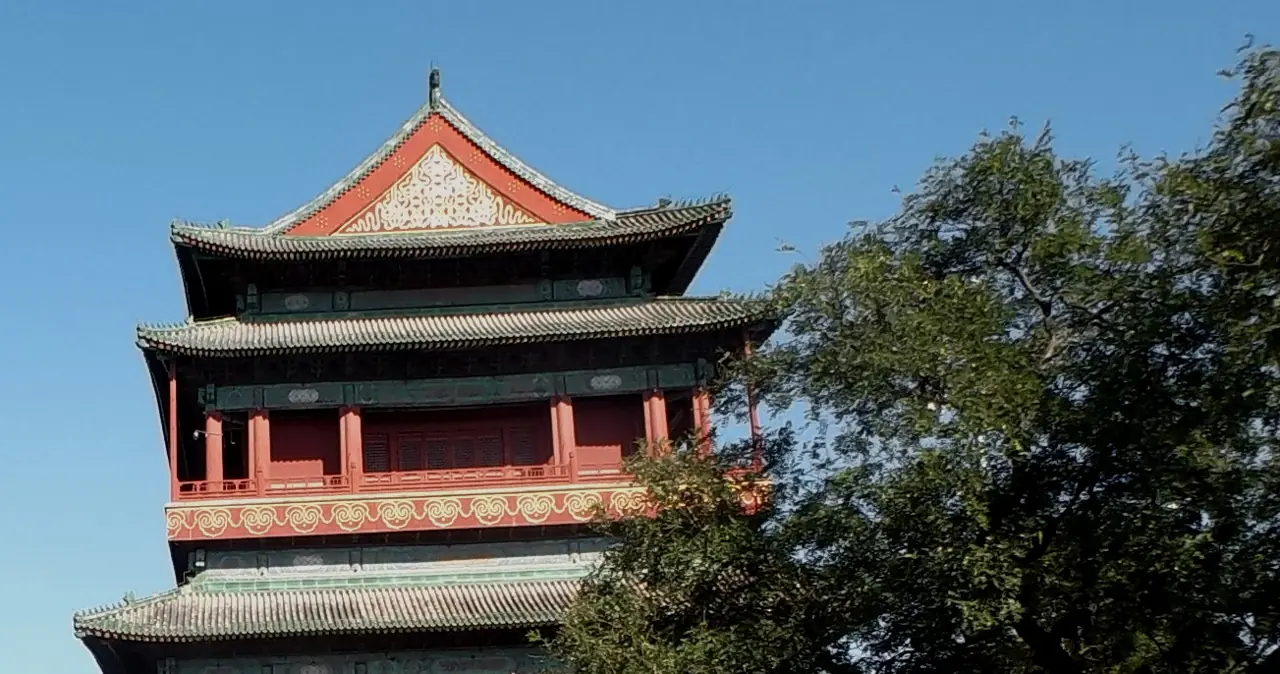
Climbing Beijing’s Bell and Drum Towers brings you closer to the instruments once used to mark the city’s time: large drums in the Drum Tower and a huge bell in the Bell Tower. Choose the Drum Tower for its drum displays, the Bell Tower for the bell, or both to connect the instruments with their neighboring buildings. A drum performance needs a separate check of the day’s schedule.
Choose one tower or visit both
The towers stand at the northern end of Beijing’s Central Axis, with the Drum Tower to the south and the Bell Tower to the north. Save both map names: Drum Tower, or Gulou (鼓楼), and Bell Tower, or Zhonglou (钟楼). They are separate buildings, so choosing a ticket also means choosing which interior you want to see.
From outside, the red upper levels of the Drum Tower contrast with the Bell Tower’s gray exterior. The photograph below shows the Bell Tower beyond the paved square. Its position helps make sense of the pair before you enter; the objects inside give each tower its own reason for climbing.
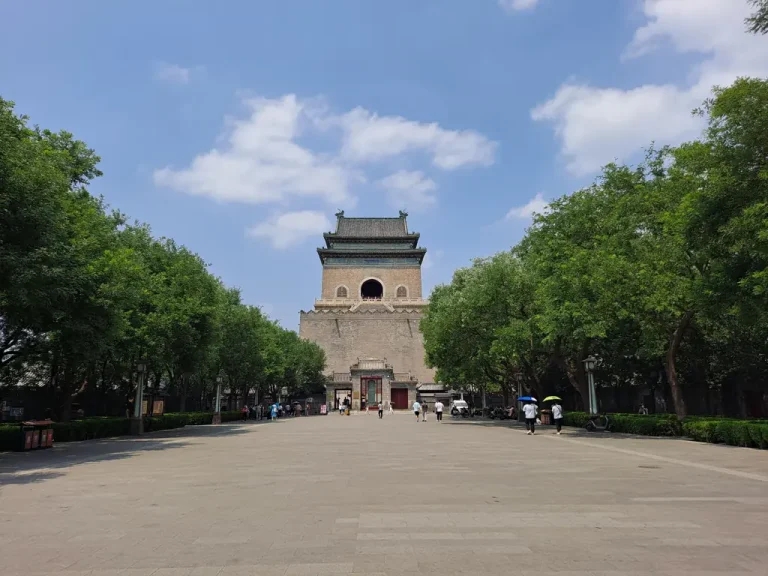

For a visit centered on drums, I’d choose the Drum Tower and settle the performance question before buying. The Bell Tower makes sense if the bell is the object you’re most curious about. Visiting both gives you the comparison, provided everyone in your group wants the climbs as well as the displays.
If you’re choosing between this stop and other parts of the city, the Beijing destination guide groups the site’s Beijing visits. Give the towers a place in the day based on the interiors you want to see, rather than simply passing the same landmark twice.
Drum Tower: drums, timekeeping and the climb
The Drum Tower is the choice for the drum exhibition. Beijing’s municipal government describes the building’s historical role as timekeeping and its present attraction as large-drum displays with regular performances. Read the exhibition with that purpose in mind: the drums helped mark the rhythm of the city’s day.
Try separating two questions as you read the labels. How was time determined, and how was it announced? The distinction helps connect any explanation of a timing device with the drums themselves. Use the labels beside individual objects to establish their names and roles; an exterior view can’t tell you which historic instruments are currently displayed.
A performance adds sound to that explanation, but “regular performances” doesn’t establish a session for your visit. Ask which sessions are running that day, where visitors should wait and whether the next one fits within your admission arrangements. If hearing the drums is your main reason for climbing, get those answers before committing to the visit.
The climb deserves attention too. A Beijing government photo feature explicitly describes steep stairs inside the Drum Tower. Anyone concerned about stairs should ask staff about the current visitor route before buying a climbing ticket. This guide hasn’t established a step-free route or counted the steps.
Bell Tower: the bell and the building have different dates
After the drum exhibition, the Bell Tower shifts attention to the bell used for announcing time. The municipal government’s account dates the enormous bell to the Yongle period of the Ming dynasty, while the present tower was rebuilt during the Qing dynasty. Those are different parts of the same visit: the instrument and the structure sheltering it.
That distinction is useful when reading a date on a label. Check whether it describes the casting of the bell, a phase of the building or a later repair. A tower’s rebuilding date alone doesn’t date the object inside it. The government account also places the Drum Tower building in the Ming dynasty.
I’d give the bell a deliberate pause, even if there’s no scheduled activity. Look at its shape and how it hangs from the permitted visitor area, then read the labels beside it. A visitor ticket doesn’t establish a right to strike the bell, and the sources checked for this guide don’t confirm a visitor bell-ringing activity.
The photographs used here show the buildings’ exteriors. For a trip whose main aim is the palace roof panorama, Jingshan’s Wanchun Pavilion viewpoint means climbing a different hill and checking the park’s entry rules. Choose the towers for the timekeeping story rather than expecting that particular palace view.
Tower tickets, seasonal hours and passport questions
Before choosing both climbs, check admission for your date. On November 15, 2026, Beijing’s official Central Axis page listed full-price tickets at CNY 20 for the Drum Tower, CNY 15 for the Bell Tower and CNY 30 for the combined ticket. Buying both separately totals CNY 35; the published combined price saves CNY 5 if you intend to enter both.
The same page lists opening hours of 9:30 a.m.–5:30 p.m. from April 26 through October 25, and 9:30 a.m.–4:30 p.m. from October 26 through April 25, all Beijing time. November falls within that shorter published season. Check current holiday and temporary notices as well as the hours before setting off.
The prices and seasonal hours appear together on the Beijing government’s Central Axis visitor page. Ticket sales and admission have their own deadlines, so closing time alone isn’t a useful arrival target. Confirm the current cutoff for a single-tower or combined ticket and leave usable time for the actual visit.
Foreign-passport purchasing and any advance-reservation requirement remain unverified for this guide. Ask the tower operator how to book with your travel document, which entrance to use and what the chosen ticket covers. A posted price doesn’t resolve those questions, and a performance session may still need checking separately.
Make room for the tower interiors in a Beijing day
Once admission and the day’s sessions are settled, choose the tower order around any performance you want to attend. Allow separately for entry checks, the climbs, reading the displays and moving between buildings. People who want to study the labels will need a different pace from visitors primarily interested in the architecture.
The site’s Beijing one-day itinerary starts its hutong alternative outside the towers before continuing toward Shichahai. Adding the interiors changes that day: shorten the later wandering to give the exhibits and any performance room. A visit inside each building deserves more than the time needed to photograph it from the square.
For a walk afterward, the Bell Tower and Dashilan hutong routes explain separate street outings, including a northern out-and-back from the Bell Tower area. Choose that extension after deciding how much time and energy remain from climbing. Keep the tower ticket and any performance session as the fixed part of this stop.
Written by Alex Chen, founder and editor of China Culture Way.
Photo credits
Photo: Hermann Luyken / Wikimedia Commons / CC0 1.0. Cropped to the upper tower architecture to exclude close visitors and shopfronts; resized and compressed to WebP. Original image and derivative dedicated under CC0 1.0.

Explore the Beijing city guide →