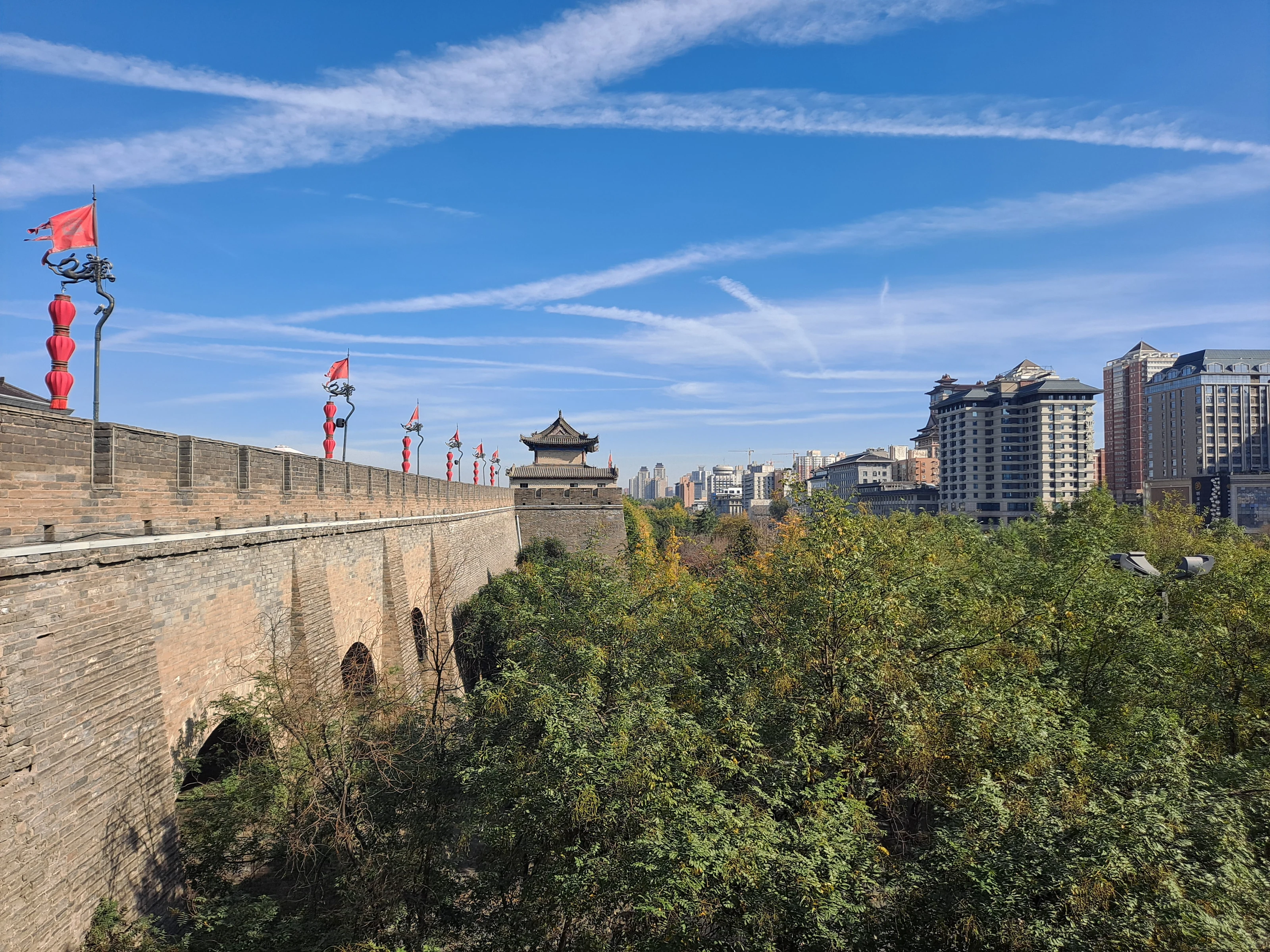
Xi’an City Wall is an 8.5-mile (13.74 km) circuit around the old city, but visiting it doesn’t require completing the loop. For a first visit, I’d start at Yongningmen, the South Gate, and walk a manageable section. Choose a bicycle if covering more of the wall matters to you and the rental terms fit your plans.
The standard full-price admission is CNY 54. Foreign-passport visitors have a window step to complete before entry, even after buying online. Tickets, the gate you choose, and the bike’s return point all affect how much of the wall you can comfortably enjoy; the sections below work through those decisions before explaining what to look for along the walls.
Xi’an City Wall tickets and foreign-passport entry
Buy admission for the wall itself when your goal is walking or cycling on top. A product carrying the attraction’s name may instead cover a moat cruise, a performance or a guided excursion. Read the inclusion line before paying, especially if a booking page shows several packages under the same heading.
Qujiang’s government ticket-policy reply, published in August 2025, gives a full-price rate of CNY 54 and a half-price rate of CNY 27. The lower rate depends on eligibility and documentation. Use the full-price figure as the ordinary admission budget, then check the dated product for any event conditions and confirm concessions with the operator.
The entry procedure changed on July 1, 2026. Under the attraction’s notice, overseas visitors who purchase online take the identification entered in their booking to a ticket window and exchange the order for a paper admission document. At entry, staff scan that document and conduct facial verification. Keep time for the window visit before heading toward the ticket checkpoint.
Foreign visitors can also register their information and buy at a ticket window. For an online booking, check whether the purchase form accepts your passport before you pay. A September 2026 Qujiang report says nine wall ticket windows accept overseas bank cards, without identifying every gate or card type.
Bring the original booked ID and any concession documents. For another form of identity verification, ask at the gate’s ticket hall. The July 2026 City Wall entry notice, reproduced by Shaanxi Daily, explains these options.
For the other major sight in your Xi’an plans, use the Terracotta Army ticket guide separately. That museum has its own real-name booking requirements; the wall’s window procedure doesn’t establish admission there.
Start at Yongningmen, then choose a wall exit
Once the ticket arrangements are clear, select a specific gate instead of navigating to the attraction’s general map pin. I favor Yongningmen for a first visit because it’s the South Gate and the operator directly publishes its opening hours. Save its Chinese name, 永宁门, so you can recognize it on local signs and map listings.
These four historic gate names help you orient yourself around the wall. Their position says where you’ll enter; it doesn’t establish the hours of the ticket window, a bicycle desk or another exit.
| Wall side | Gate name | Chinese name |
|---|---|---|
| South | Yongningmen | 永宁门 |
| East | Changlemen | 长乐门 |
| West | Andingmen | 安定门 |
| North | Anyuanmen | 安远门 |
There are more access points than these four. Qujiang listed 17 ascent and descent points in July 2025 and confirmed the expanded network again in July 2026. The list includes both sides of Yongningmen, Hanguangmen, Wenchangmen, Wumumen and several corner access points.
A wall map helps distinguish the path on top from streets beside it at ground level. Shuncheng Lane runs below the wall with places to eat and drink. To finish there, identify a working descent point first; being beside the street on a map doesn’t provide a way down.
For step-free access, ask about the exact gate and route before buying. Equipment or services mentioned in a news report don’t establish that your chosen entrance works for a wheelchair. The useful question is whether the operator can confirm the complete route from the ticket window to the area you want to visit and back down.
The Xi’an destination collection places the wall alongside the city’s other main sights. Settle the wall’s entrance and exit before combining those stops into your day.
Walking or cycling the 8.5-mile city wall
The gate gives you a starting point; the distance determines the scale of the outing. A full circuit is 8.5 miles (13.74 km), so treat it as an activity in its own right. Walking works well for examining a gate complex and pausing over the city views. Cycling makes more sense when seeing several sides of the old city is the priority.
A short wall walk with a known return
For a short first visit, I would reserve roughly an hour to an hour and a half on top, then add time for tickets and reaching the gate. That’s a planning allowance for a section with stops, not an official walking duration or a claim that the whole circuit fits into it. The stopping point can be a view you like.
An out-and-back walk keeps the return simple: leave from your chosen gate, walk until the time you’ve set aside for the outward leg is used, and return along the same section. A one-way section can work too, provided the second descent point is confirmed. Save the exit’s name rather than relying on finding a convenient staircase later.
Use the pauses to look both inward and outward. The wall lets you compare streets inside the perimeter with the moat and buildings beyond it. Walking leaves time for those changes in perspective and for signs explaining the structures. If the view is what brought you here, a satisfying section is a better measure of the visit than distance completed.
Bike rental: decide the return before the distance
Bicycle riding remains a current attraction activity: Qujiang’s July 2026 reply describes it alongside walking. I haven’t verified a current official rental-price table or complete return rules. The rental desk’s terms should decide whether you ride a section or the whole circuit, especially when you have a fixed dinner booking or departure afterward.
Before accepting a bicycle, ask these questions together:
- What is the total hire charge, included time and refundable deposit?
- Which return points are operating today, and can this bike go to another one?
- What are the last rental and return times?
- What rider restrictions, equipment and overtime charges apply?
Then choose a distance that fits the answers. Suppose you want to walk outward and cycle back: that plan depends on finding a working hire point at the far end and being allowed to return the bicycle where you began. If the desk can’t confirm both, choose the bike ride from the outset or keep the walk as an out-and-back.
Check the bicycle with the attendant before setting off and follow the route instructions given there. Leave room for people walking and stop before taking photographs. Bring water and choose conditions your group is comfortable moving in; a shorter walk is a useful alternative when the weather, surface or available bicycle makes riding unattractive.
Xi’an City Wall hours and an evening finish
An evening visit needs a return plan as much as a daytime bike ride does. When checked on October 12, 2026, the operator’s website displayed South Gate hours of 08:00–22:00, Beijing time. Its detailed-hours link returned no readable information, so I couldn’t verify a current complete table for other gates or a last-entry cutoff.
Before setting off, confirm the opening and last-entry times for the gate you plan to use. For cycling, confirm the return deadline separately. The wall’s closing time and the end of a rental service are different questions; ask both when choosing how late to begin. The operator lists its contact number as +86 29 8727 2792.
For daylight views followed by an evening look at the gate, I would leave the afternoon flexible and arrive while there is still light. Check that day’s weather and sunset time when fixing the start. Lighting and performances have their own arrangements, and earlier official lighting replies describe scheduled operation, so a photograph of an illuminated gate isn’t a promise for your evening.
Give the descent and onward journey their own space in the day. A train departure is a reason to choose a shorter section with a clear exit. Dinner can be easier to arrange after you know where you’ll finish, particularly if you want to spend longer looking at the gate or the city beneath it.
If the museum is also on the day’s schedule, the Xi’an–Terracotta Army transport guide covers its outward and return journey. Allow that travel first, then decide how much wall time remains.
Read the Ming wall against modern Xi’an
With the practical arrangements settled, the wall offers a way to understand Xi’an’s shape. The surviving enclosure is a Ming-period fortification built on earlier foundations, including those of the Tang imperial city. Later repair campaigns changed and restored it. Those layers explain why the history of a visible structure is more specific than the age of the city around it.
At a gate, look for how the entrance, towers and surrounding wall work together. Away from the gate, follow the perimeter with your eyes and compare the street pattern inside it with movement outside. The moat adds another part of the defensive layout. I find that relationship more useful to look for than trying to identify every roof as ancient.
The setting makes a ground-level walk a natural continuation. Shuncheng Lane follows the wall below, while the broader old city contains the Bell Tower and Muslim Quarter. For a meal there, the Muslim Quarter food guide explains dishes and questions to ask at a stall. Choose your next stop to suit the confirmed exit and your remaining energy.
Before leaving the wall, take one last look across the boundary. Which streets lead toward its gate, and how does the modern city move around it?
Explore the Xi’an city guide →