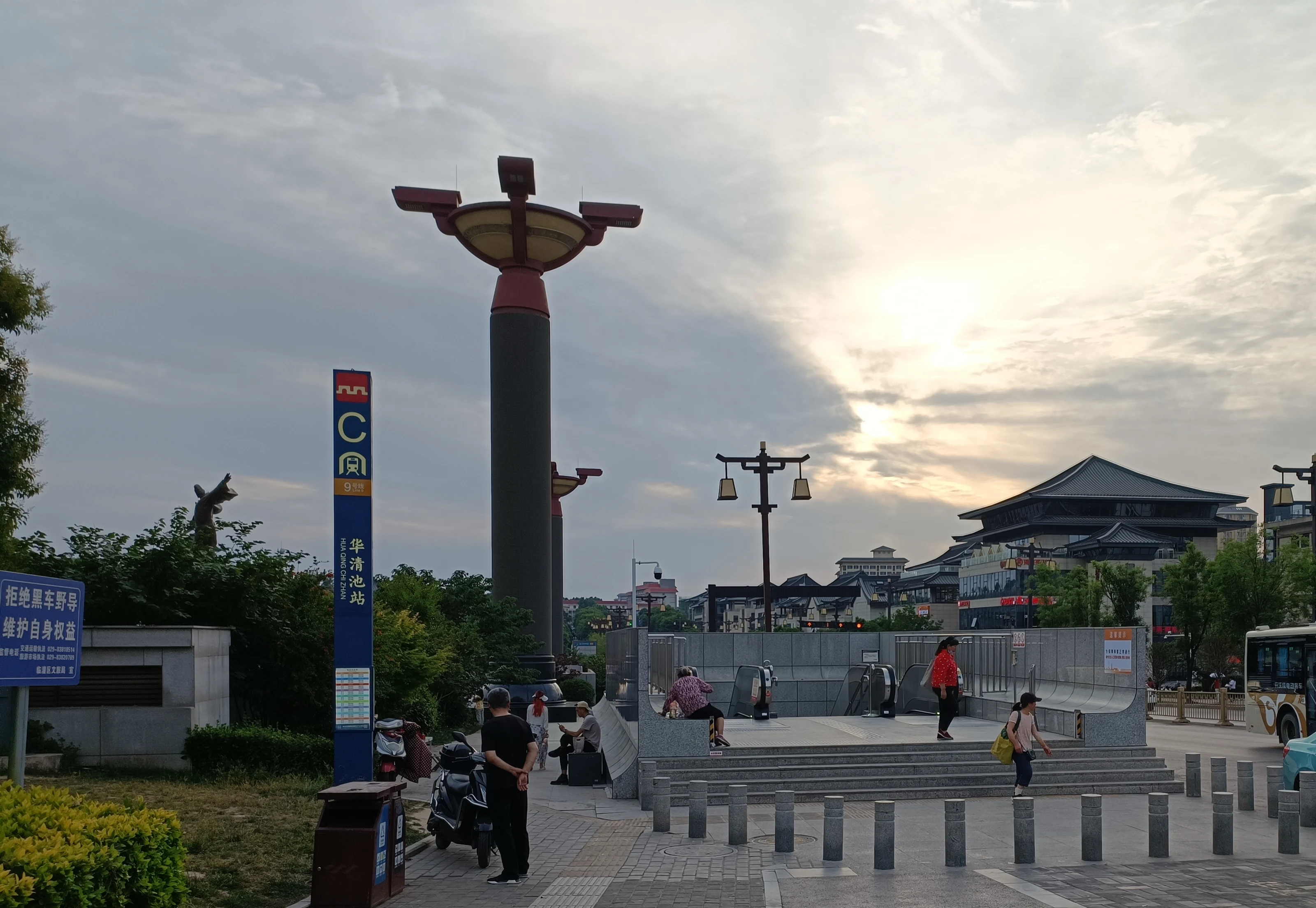
The metro journey from Xi’an to the Terracotta Warriors ends at Huaqingchi, with a bus or car still needed to reach the museum. Take Line 1 to Fangzhicheng and transfer to Line 9 for Huaqingchi. A car booked from your hotel can take the transfers out of the journey; agree on the ride back at the same time.
Your starting station changes the first train; the museum’s North Gate and your reservation determine the arrival plan. Those are the details I’d settle before choosing between public transport and a car.
Featured image explanation: Huaqingchi Station, Line 9, Exit C. The blue notice warns against unlicensed taxis and unauthorized guides.
The metro route from Xi’an to the Terracotta Warriors
Fangzhicheng is the transfer point between Line 1 and Line 9; Huaqingchi is where the museum’s recommended metro route gives way to a road journey. The museum’s directions then list local buses toward the Terracotta Army. Treat Huaqingchi as a connection in the journey, with time still needed for the bus, the walk and entry checks.
Start from your hotel’s address and join the metro there, rather than going first to a railway station. Around the Bell Tower, ask the hotel which stop makes sense for reaching Line 1 toward Fangzhicheng. The hotel address decides where to begin this journey.
I’d choose this route when changing trains and arranging the final bus fit comfortably into the day. If handling luggage or keeping a group together makes those changes awkward, a car is worth comparing. Its useful advantage is a journey arranged from your starting address; the price and return terms still need agreement.
Use the museum’s transport directions to compare the official route with the service available on your date. For the rest of the visit, the Xi’an city guide separates this excursion from the sights in the historic center.
Xi’an North and Xi’an Railway Station: different first trains
The shared route through Fangzhicheng begins differently at Xi’an’s two railway stations. Look at the full arrival-station name on the train ticket before planning the connection. “North” changes the first metro line and the station where the route joins Line 1.
| Arrival station | Metro route listed by the museum |
|---|---|
| Xi’an North, 西安北站 | Line 2 to Beidajie → Line 1 to Fangzhicheng → Line 9 to Huaqingchi |
| Xi’an Railway Station, 西安站 | Line 4 to Wulukou → Line 1 to Fangzhicheng → Line 9 to Huaqingchi |
Beidajie (北大街) and Wulukou (五路口) are the different interchange names to look for. Fangzhicheng (纺织城) comes next in both routes. Follow station signs to make each transfer, then keep the Huaqingchi road connection separate from the train ride when estimating the arrival time.
Luggage needs a decision before leaving the station. The museum lists free storage after security screening, behind the LED wall east of the ticket hall, with exclusions including phones, computers, other digital products, documents and valuables. I’d leave a large travel bag at the hotel when practical; a suitcase containing electronics needs more planning than simply assuming everything can go into museum storage.
From Huaqingchi to the Terracotta Warriors entrance
At Huaqingchi, the next task is to identify the onward bus and its direction. The museum uses Exit C in its airport-route examples. Its railway-station directions describe the bus connection after leaving the station, so Exit C alone doesn’t establish the current boarding point.
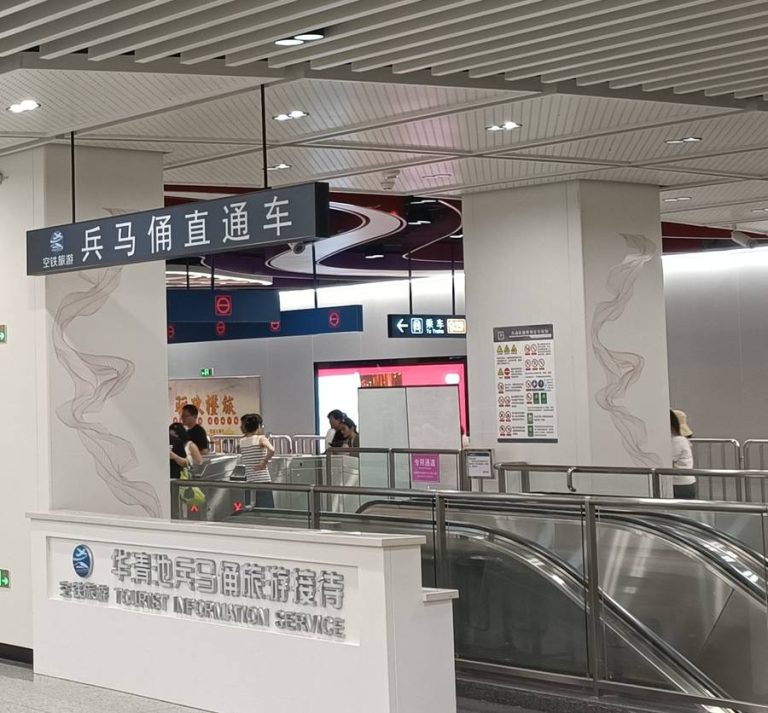
Photo credits
The sign reads Terracotta Army direct bus; the counter identifies a tourist information service. The overhead arrow points to trains. This historical photograph does not establish today's service.
Photo: Bob Wehn / Wikimedia Commons / CC BY-SA 4.0. Cropped to remove foreground close faces, resized and compressed. No retouching. Derivative under CC BY-SA 4.0.
For journeys from either railway station, the museum lists Lintong Tourist Bus 613 (临潼游613路) to Qinyongcun (秦俑村), or Lintong Bus 602 (临潼602路) to Qin Bingmayong (秦兵马俑). Show the museum destination to the driver and confirm the stop before boarding. Keep the Chinese names handy because the two official descriptions use different stop names.
The bus stop and the entrance are separate points. The museum’s ticketing instructions require visitors to enter through the North Gate, with a one-way route through the site. After getting off, follow the museum’s current entrance signs or ask staff for the North Gate. The short walking distances in individual official examples apply to those examples, rather than every possible drop-off.
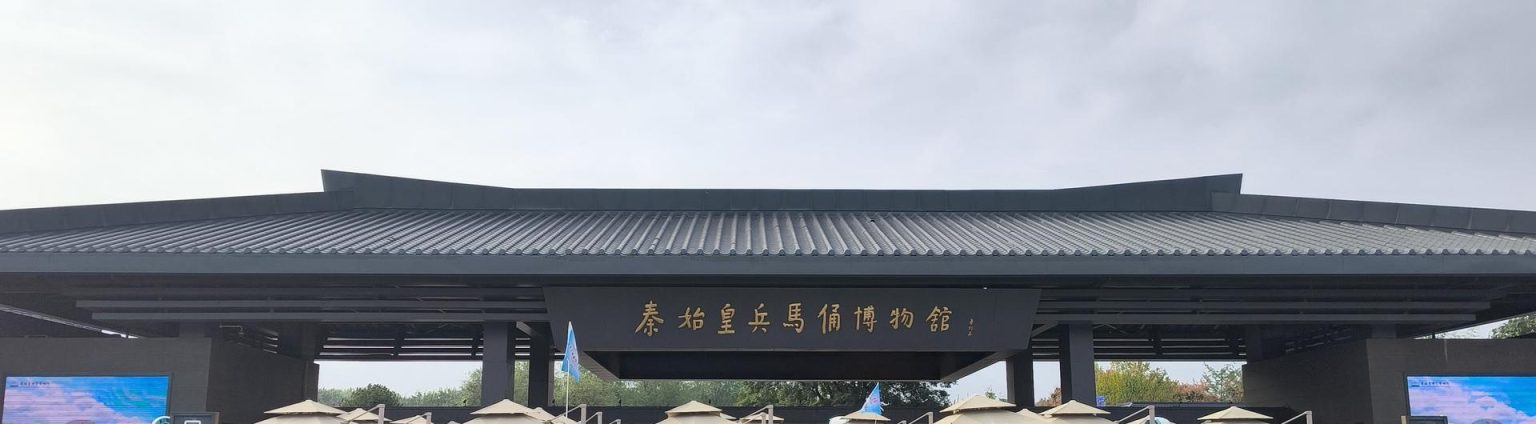
Photo credits
The Chinese gate name means Qin Shi Huang Terracotta Warriors Museum. Photographed October 8, 2023.
Photo: 源義信 / Wikimedia Commons / CC BY-SA 4.0. Cropped to remove foreground close faces, resized and compressed. No retouching. Derivative under CC BY-SA 4.0.
Confirm the day’s fare, boarding location and return service locally before committing to the bus. I haven’t verified a current operator timetable for Bus 306 or a free direct shuttle from Xi’an North, so neither forms the basis of this route. The Terracotta Army ticket and passport guide covers the reservation and document checks awaiting you at the entrance.

A car from Xi’an: agree on both journeys
A car changes who handles the road connection, but the museum arrival still needs a clear destination. Give the booking contact “Terracotta Army Museum, 秦始皇兵马俑博物馆” and ask where the vehicle can drop passengers for North Gate entry. A broad destination such as “Lintong” leaves too much of the journey unresolved.
I want the booking to state where and when the driver will come back, because the route through the museum is one-way. These questions make the service easier to compare:
- Does the price cover a one-way drop-off, a waiting driver, or a separate return pickup?
- What are the exact pickup address and meeting point, and how will driver and passengers contact each other?
- Are parking and waiting charges included, and what happens if the visit runs longer?
- Does the booking include admission or a guide, or is it transport alone?
For a railway pickup, give the full station name from the ticket. For the return, name the hotel or departure station just as precisely. If choosing a tour, apply the same questions to its meeting point and return destination.
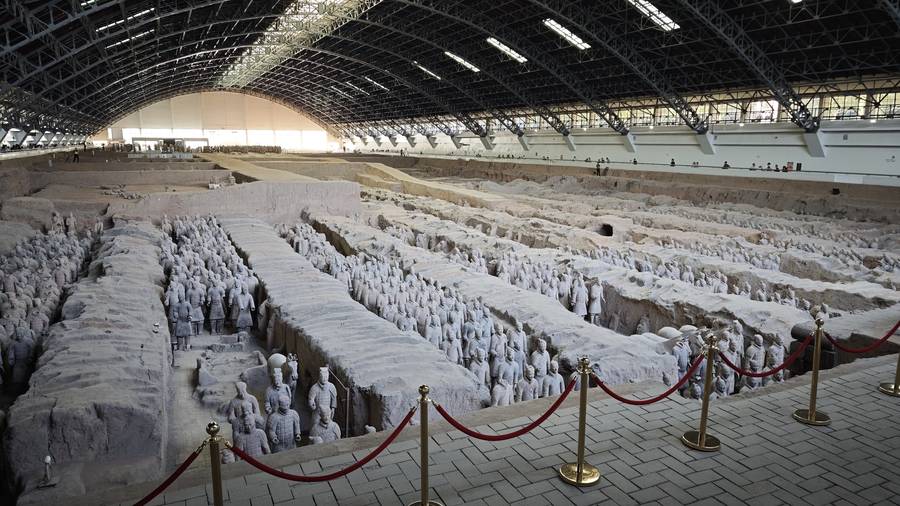
Transport gets you to the site; a guide helps make sense of what you see. Reading about the army’s discovery and three pits supplies background for a visit on your own.
Timing the return from the Terracotta Warriors
Whichever transport you choose, work backward from the museum reservation. Its instructions ask visitors to wait 30 minutes before their reserved time. Allow separately for the journey, the final walk and finding the entrance; a map’s arrival at a nearby stop leaves those tasks unfinished.
The museum comprises the Terracotta Army site and Lishan Garden, its mausoleum archaeological park. The museum suggests about 1.5 hours for each and lists a free shuttle between them. Those visit estimates leave the transfer, waiting and your own pace to add. Decide whether to visit both before setting a driver’s pickup time or arranging an onward train.
Lishan Garden and Huaqingchi belong to different parts of this plan: the former is the museum’s second visiting area, while the latter is the metro connection described above. After visiting, follow the signed exit and find the actual return boarding or pickup point. The North Gate’s entrance role doesn’t make it the automatic meeting point on departure.
If returning by public transport, confirm the bus back toward Huaqingchi and the metro connections while there is still flexibility in the afternoon. I wouldn’t build a train connection around an unverified last bus. If a City Wall visit is also on the day’s list, compare the City Wall gates and visit options with the time remaining after the return journey.
Finish the plan with an exact return destination. “Xi’an” is enough for a conversation about the city; a booked driver or a train connection needs the hotel address, Xi’an Railway Station, or Xi’an North.
Photo credits
Photo: Bob Wehn / Wikimedia Commons / CC BY-SA 4.0. Cropped to remove foreground close faces, resized and compressed. No retouching. Derivative under CC BY-SA 4.0.

Explore the Xi’an city guide →