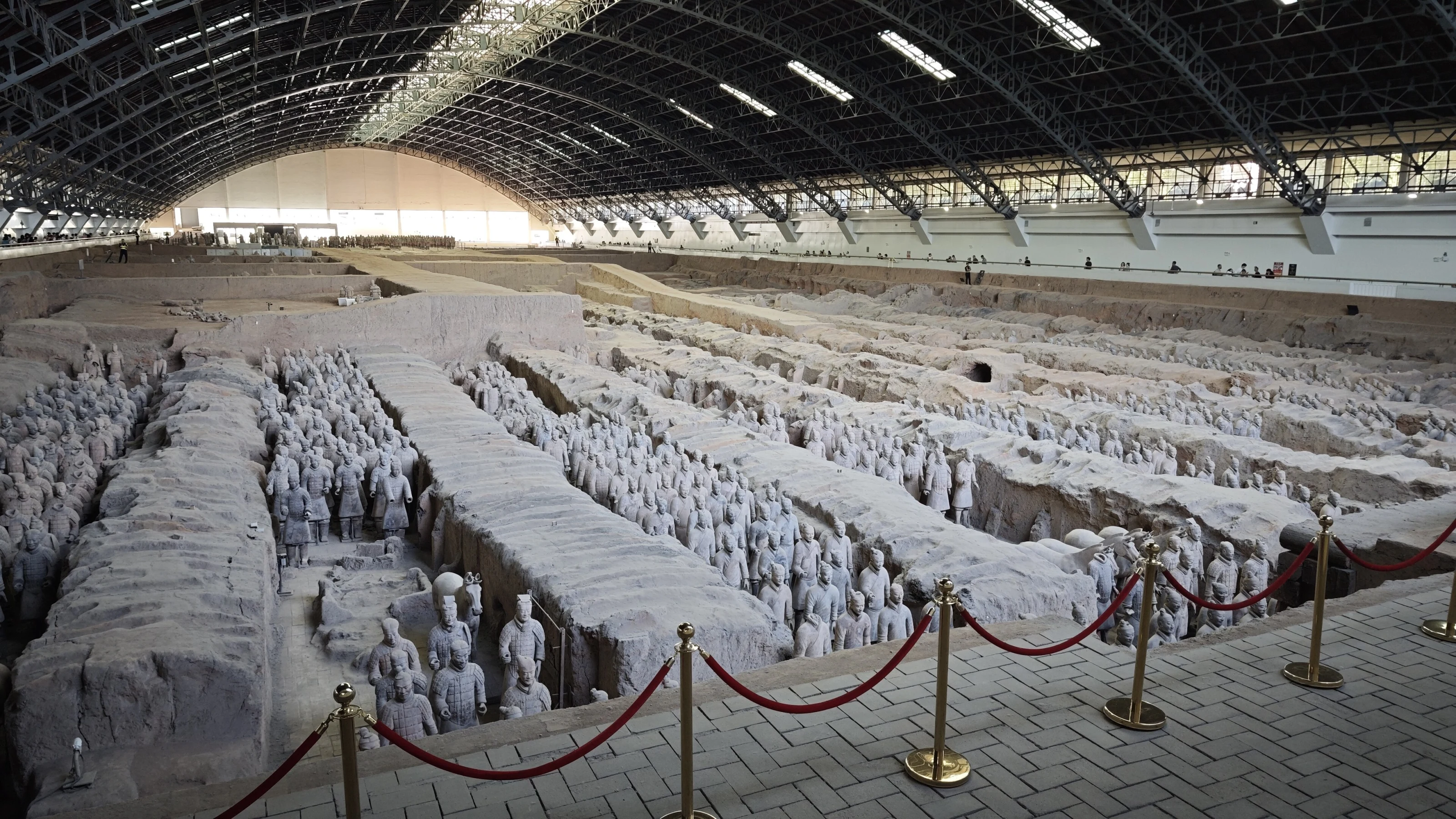
The Terracotta Army was buried in the third century BCE to accompany Qin Shi Huang, China’s first emperor, into the afterlife. Its discovery began with villagers digging a well in 1974. At the museum near Xi’an, the pits reveal an army’s organization, while individual figures reveal the work of sculptors and the challenge of preserving painted clay.
The history makes more sense when the army, the digging and the way the figures look today fit together. The sections below follow that path, from the emperor’s burial complex through the three pits to the faces and color of the warriors.
Why Qin Shi Huang buried a terracotta army
Qin Shi Huang unified China in 221 BCE and died in 210 BCE. The warriors belong to his burial complex, where a military force formed part of the world prepared for him after death. UNESCO describes the wider site’s layout as a reflection of the Qin capital, Xianyang.
The distinction between the army and the emperor’s tomb matters on a visit. The warrior pits are accompanying burial pits; looking into them means looking at one part of an extensive imperial complex. The soldiers’ scale and arrangement make sense as an expression of imperial power, rather than as statues made for public admiration.
I prefer to read the objects alongside the site plan before dwelling on the emperor’s deeds. Locate the army in relation to the burial mound before focusing on a face. That keeps the whole funerary setting in view as a single figure draws attention.
For the wider city context, the Xi’an destination guide is the entry point to our local guides.
From a village well to the Terracotta Army museum
The army’s modern history began with fragments, followed by surveys and test digs. In March 1974, farmers at Xiyang village found pieces of pottery figures while digging a well. The museum’s Pit 1 account explains how that later work mapped out the extent of the large pit.
Three dates help separate the discovery from the museum that visitors enter:
| Date | What happened |
|---|---|
| 1974 | Well digging exposed fragments that led to the investigation of Pit 1. |
| 1976 | Pits 2 and 3 were discovered. |
| 1979 | The protective hall over Pit 1 opened to visitors. |
The standing army also owes its shape to careful repair. Digs recover broken objects as well as intact details, and restorers bring fragments back together. The museum’s historical account describes the work of digging and caring for the finds; its old totals belong to that account’s period, not the number of figures on display today.
That difference helps when reading a label. “Estimated,” “excavated” and “restored” answer different questions about the same army. A headline number for the original burial does not promise a matching number of upright figures during a visit. Admission arrangements are a separate part of preparation, covered in the Terracotta Army ticket guide.
How to read the three Terracotta Army pits
The three pits discovered in the 1970s offer different ways to understand the army. Pit 1 gives the broad view of scale and rows; Pit 2 helps explain different military roles; Pit 3 raises the question of command. The museum’s own descriptions provide a better starting point than treating each hall as another version of the same spectacle.
| Pit | Historical clue | A useful viewing question |
|---|---|---|
| Pit 1 | The museum estimates about 6,000 pottery figures and horses from the density of excavated remains. | How do the rows and spaces organize the force? |
| Pit 2 | Different troop types form distinct units, including crossbow troops, chariot troops and cavalry. | How do poses, equipment and placement distinguish the units? |
| Pit 3 | Some scholars interpret this smaller pit as the command post for Pits 1 and 2. | What makes its layout different from the larger formations? |
The Pit 1 estimate is easy to misread. The figure counts warriors and horses inferred for the pit, rather than 6,000 soldiers already uncovered and standing. Once that is clear, exposed ground and broken figures help tell the story of the digs instead of looking like a gap in the display.
Pit 2 deserves attention beyond its size. The museum reported a new display opening for trial visits on October 1, 2026, with explanations of its military units, architecture and excavation. For a visit now, use the displays to connect a labeled troop type with a position in the formation; check the museum’s latest access notices before traveling.
For Pit 3, keep the interpretation in the museum’s wording: a command post is a scholarly explanation, not a surviving sign naming a headquarters. Comparing the plan with the other pits helps explain why that idea arose. Planning the journey from Xi’an to the museum separately leaves the historical questions for the visit itself.
Different warrior faces, different workshops
The army’s rows also contain a great deal of careful modeling. A broad view gives the army its force; a closer look brings out clothing folds, facial features and hair. Choose a pair of figures and compare one detail at a time, so that “all different” becomes something to see rather than a phrase to memorize.
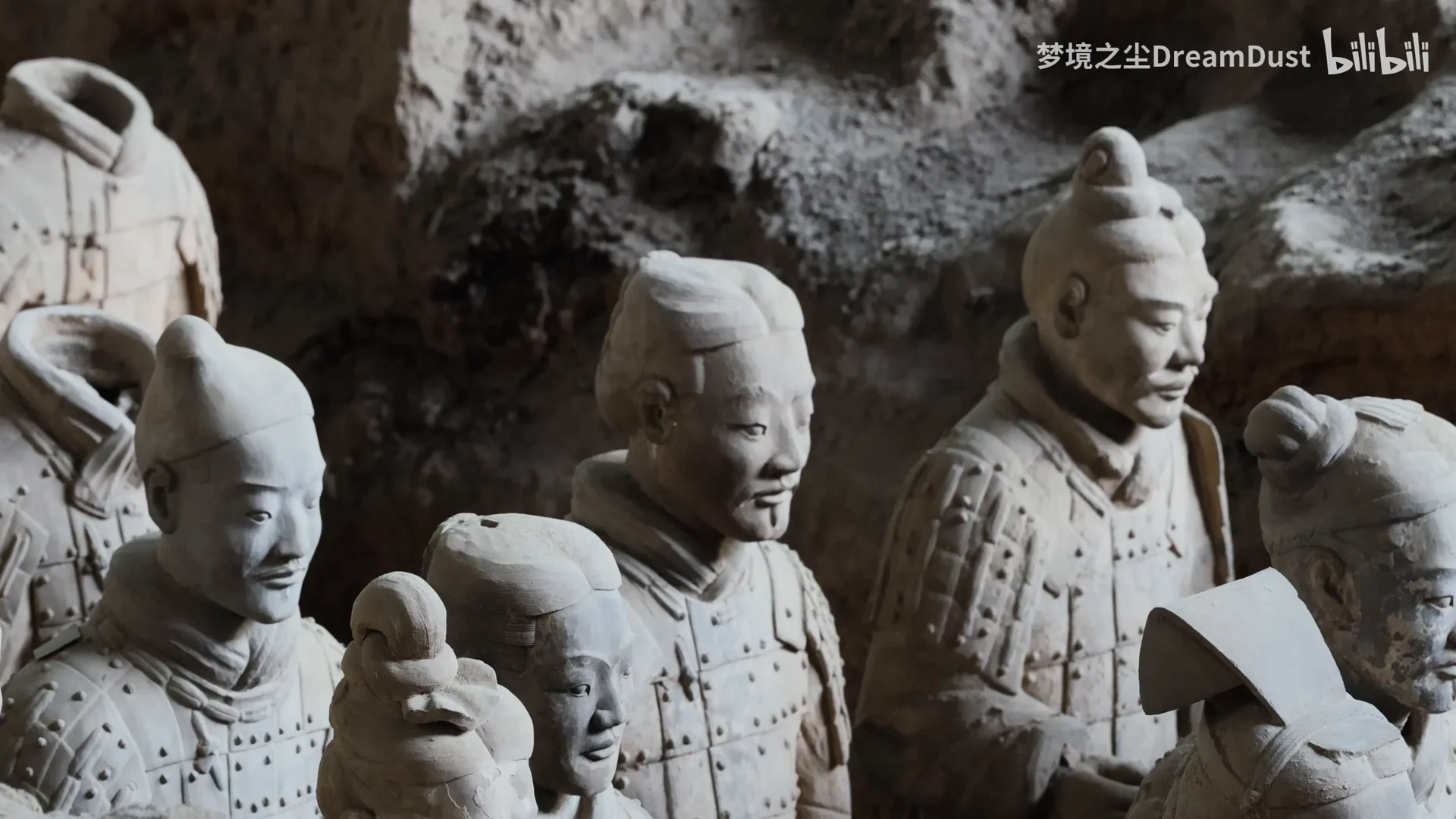
Photo credits
Photo credit: “Terracotta warriors” by TarnishedPath / Wikimedia Commons. Original work. Resized and compressed to WebP; full photograph retained. This version is available under CC BY-SA 4.0.

Varied faces are evidence of artistic choices, but they do not establish that each figure is a portrait of a named soldier. The museum’s account of figure heads describes an initial molded form followed by further work on the features and beard. Individuality and repeated production methods could coexist.
How the workshops worked together is still a research question. In a 2020 report, the museum described its joint study with University College London: chemical analysis of 28 figures and horses supported a possible supply system involving different workshops. That evidence is more specific than picturing one vast assembly line, and the report presents it as a proposed production model.
For the visitor, the useful move is from likeness to workmanship. Look at the edges of modeled armor, a belt or the shaping of a topknot. A label identifying a figure’s military role can then add context to the detail, without asking a face alone to prove a rank or a personal identity.
Why the Terracotta Warriors lost their painted color
The modeled clay once carried painted decoration. Much of that color suffered during burial, and surviving paint faced another danger when excavated. The museum’s conservation account describes a lacquer coating beneath the pigments: as the wet lacquer dried, it shrank and curled, lifting the paint away from the clay.
Researchers developed treatments to stabilize surviving painted layers, and the museum’s account records successful preservation of painted figures. The familiar clay-colored army gives an incomplete impression of its original appearance.
When studying a color display, establish what is in front of you: an original surviving trace, a conserved object or a reconstruction of an earlier appearance. The caption is essential because a bright reconstruction and a small patch of ancient pigment carry different kinds of evidence. Read which part of the object supports the proposed color scheme.
A tiny surviving patch can be worth a longer look than an entire row of bare clay. Follow the pigment to the feature it once described—a sleeve, an armor strap or a painted face—and the army begins to recover some of the appearance its makers intended.
Explore the Xi’an city guide →