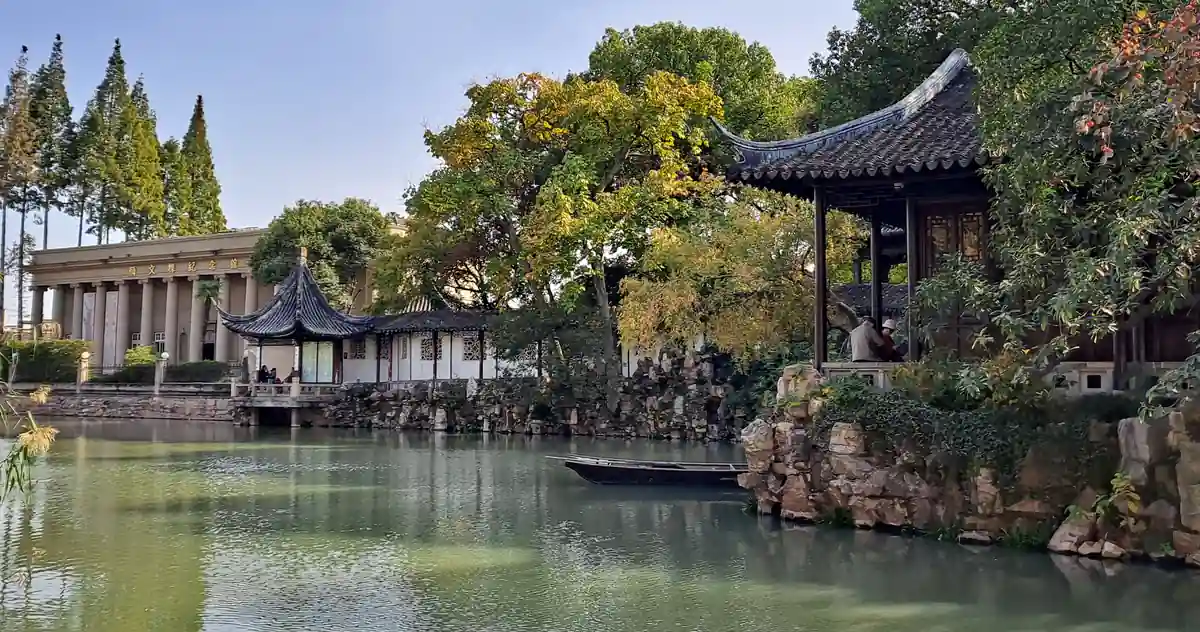
Canglang Pavilion in Suzhou brings water outside the garden into the experience of looking from within it. The waterside double corridor and its patterned openings connect the planted interior with that outer water. Give those relationships your attention: a broad view beside the garden, a passage between scenes, then a smaller view through the wall. The garden’s edge is part of the attraction.
Begin with the water outside Canglang Pavilion
The outer water gives the corridor a purpose beyond getting visitors from one building to another. In its April 2020 description, Suzhou’s Gardens and Landscaping Administration explains that the garden draws the winding Fengxi waterway into its scenery. Along the water, a double corridor and openwork windows allow views between the inside and outside.
Borrowed scenery means including something beyond a garden’s own boundary in the view enjoyed from it. Here, the outside water belongs to that larger scene. A wall still marks an edge, but the water remains visible through openings. You can notice the boundary and look beyond it at the same time.
I’d begin by noticing where the water lies in relation to the white corridor wall, whenever the current public approach allows that view. Leave the names of individual halls for later. The useful first question is simple: how does a garden make use of scenery on the other side of its wall?
For a contrasting visit organized around central ponds, the Humble Administrator’s Garden guide explains its eastern, central and western grounds. Canglang’s outside-water relationship gives a second garden visit a different focus.
Look through the corridor’s patterned openings
The corridor brings that outer landscape close to the planted garden. Its double arrangement faces inward and outward, with openings helping the scenes communicate. The wall does more than screen a path: each patterned gap lets a fragment of the space beyond enter the view.
In the photograph, pale patterned openings run along a white wall above a planted rocky bank and a small pool. Roof tiles and dark posts define the passage behind them. The visible garden side makes it easier to understand why the window matters: the wall has substance, yet you can still see through it.
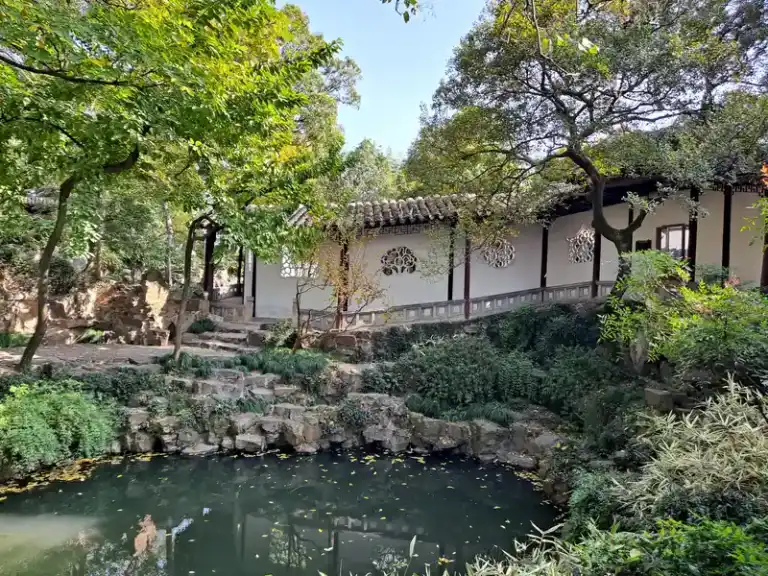

The small pool in this photograph belongs to the scene being shown; it doesn’t stand in for the winding water outside the garden. Keep the two views distinct. The point of the double corridor is the relationship between inward and outward scenery, rather than identifying every patch of water as the same place.
My suggested way of looking is to compare the solid white part of the wall with what shows through an opening. The white surface stops the view; the patterned gap admits pieces of it. There’s no need to count windows or finish a sequence. Stay on the permitted paths and let an available viewing place determine where to pause.
The Lingering Garden’s courtyards and Cloud-Capped Peak offer another use of framed garden space. At Canglang, keep returning to the water beyond the boundary as the reason for the corridor’s position.
Place the pavilion within a garden that changed over time
Beyond the waterside corridor, the garden’s history adds context to its name. The city’s account says the poet Su Shunqin bought the site in 1045 and built a pavilion beside the water. Later rebuilding changed the setting, including the relocation of the pavilion onto a mound in 1696.
Those dates describe different stages in the garden’s development. The surviving setting includes later work; calling everything a surviving Song-dynasty original would flatten that history. I’d keep the older connection with waterside retreat in mind while looking at the present garden as a place shaped across generations.
The Suzhou collection of gardens and city visits helps place this stop alongside other interests. If the day’s main purpose is traditional performance, consider the separate Master of the Nets day-or-evening choice. Canglang’s corridor and water are a reason to spend time looking closely in daylight.
Canglang Pavilion tickets and the earlier entry cutoff
That daylight visit needs an arrival time well before the garden closes. The administration’s official opening-time table, dated January 9, 2025 and checked on November 15, 2026, groups Canglang Pavilion with the gardens managed by the Lingering Garden administration. It lists these regular hours, in local Suzhou time, the same as Beijing time.
| Travel months | Regular opening hours | Ticket checking ends |
|---|---|---|
| March–October | 7:30 a.m.–5:30 p.m. | 5 p.m. |
| November–February | 7:30 a.m.–5 p.m. | 4:30 p.m. |
Holiday extensions and temporary notices can change the regular day. Check the current notice for your date, and leave room between arrival and the ticket-checking cutoff. A visit built around pausing at windows loses much of its purpose if the remaining time is only enough to hurry through.
The administration’s ticket-price table, dated July 11, 2024 and checked on November 15, 2026, lists Canglang Pavilion at CNY 20 in April, May, July, August, September and October. It lists CNY 15 in January, February, March, June, November and December. These are the published standard prices, rather than a checkout tested for this guide.
Passport checkout, document verification, whether advance reservation is compulsory, and ticket-release timing remain unverified here. Confirm those points for Canglang Pavilion through its current official ticketing channel before buying. Save the destination as 沧浪亭, Canglang Pavilion; the city’s profile gives the address as 3 Canglangting Street. Ask the operator about a continuous accessible route if that will determine your visit.
Featured image explanation: The distant building on the left bears the name 颜文樑纪念馆, meaning Yan Wenliang Memorial Hall. That name belongs to the building across the water. The photograph, taken in 2020, illustrates the waterside setting and doesn’t establish today’s vegetation or open paths.
Photo credits
Photo: 钉钉 / Wikimedia Commons / CC BY-SA 4.0. Cropped from (0,500) to (4000,2605), resized to 1200 × 632 and compressed as WebP. No retouching or text added. Derivative under CC BY-SA 4.0.

Explore the Suzhou city guide →