A visit to the Lingering Garden in Suzhou makes most sense when you give the spaces between its sights as much attention as the sights themselves. Follow how a wall opening reveals a courtyard, then give the Cloud-Capped Peak a closer look within its setting. I’d use those changes of scale to shape the visit, leaving the order of individual halls to the open visitor route.
Read the garden through corridors and framed views
The Lingering Garden uses halls, corridors, white walls and shaped openings to divide its scenery. Suzhou’s official account highlights that handling of space. A wall can hide most of the next courtyard while leaving a small, deliberate view into it; walking onward turns that glimpse into a place you can enter.
The octagonal opening in the photograph makes the idea easy to read. Bamboo occupies the nearer layer, while a doorway sits farther back. The dark edge around the opening holds those layers together. Even without seeing the whole courtyard, you can distinguish the wall you’re beside from the space beyond it.
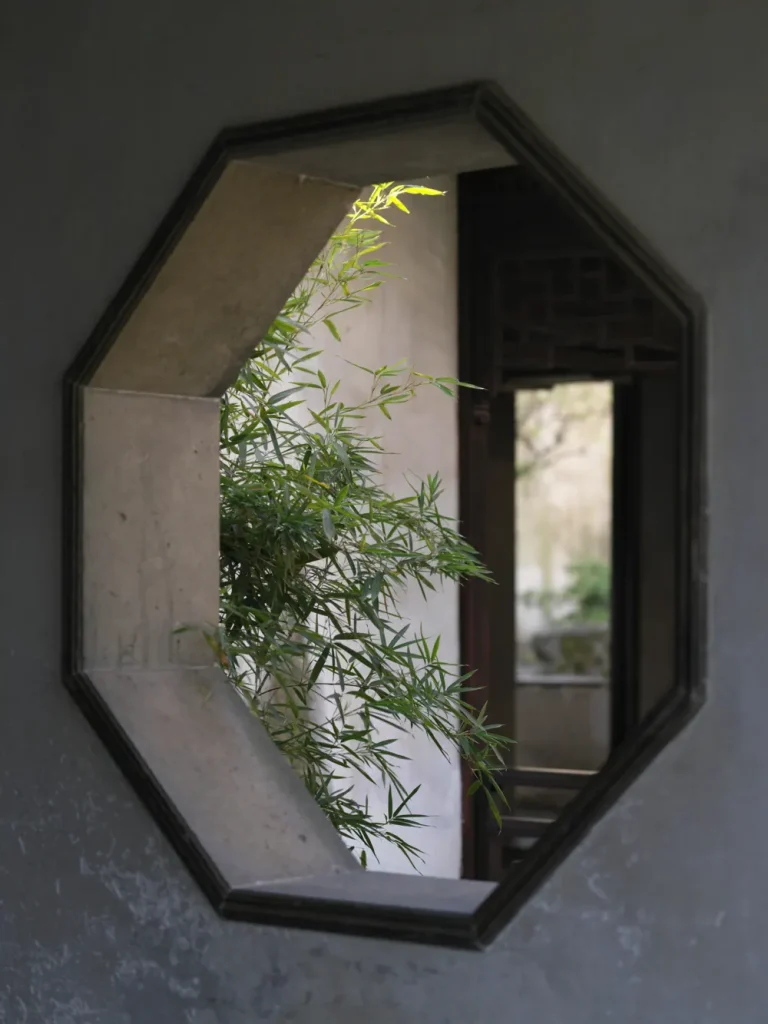
An octagonal frame, bamboo and a farther doorway create depth within a narrow view. The photograph gives a reason to notice the openings themselves, rather than treating every wall as a barrier on the way to the next attraction.
For an observation exercise, I’d choose an opening that catches my attention, look at what fills its edges, then compare the view after continuing along the permitted path. The point is to notice what becomes visible as the angle changes. That is my suggested way of looking, rather than a prescribed garden route.
Keep the passage available while stopping. The garden’s visitor notice asks people to leave corridors and entrances clear, so a tight doorway is a place for a brief glance rather than a long photo session.
Give the Cloud-Capped Peak its courtyard setting
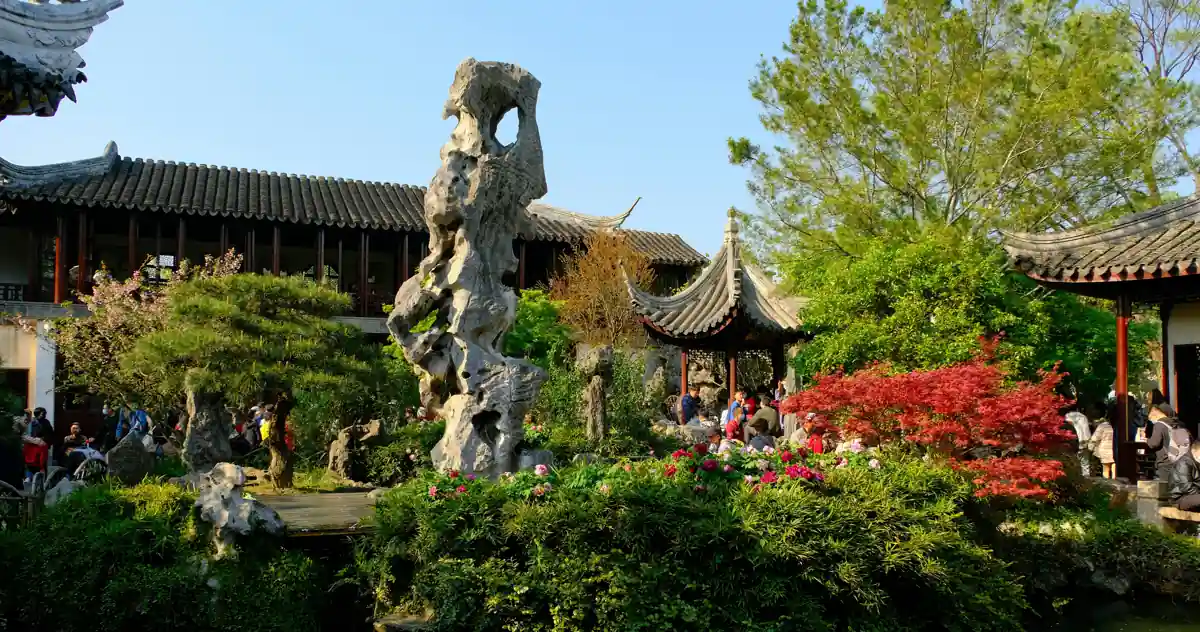
After the small views through walls, the Cloud-Capped Peak offers a tall, freestanding shape to study. Suzhou’s official Lingering Garden introduction names the rock and gives its height as 6.5 meters, about 21 feet. That figure comes from the city’s July 2021 description, rather than a measurement made for this guide.
The garden rock has openings and a narrow, uneven outline. In the featured photograph, its pale surface rises among planting, with tiled halls and covered walkways behind it. The buildings give the stone a setting in which its height and irregular shape stand out.
I’d give that relationship more attention than finding a single supposedly perfect camera spot. From an open viewing place, consider how much of the rock’s outline sits against a roof and how much sits against sky or foliage. A hole through the stone can be as striking as its outside edge when the background is visible through it.
The observation is different from navigating the passages inside Lion Grove Garden’s rockery. Here, the useful question is how a standing rock works within a courtyard composition. There is no need to turn the visit into a hunt for a passage through every rock formation.
Use the Lingering Garden’s sections to orient yourself
The courtyard setting belongs to a wider garden with distinct areas. The city’s description places courtyards and buildings in the east, a landscape garden in the center, wooded and hilly scenery in the west, and pastoral scenery in the north. Those descriptions help explain the contrasts on a map; they don’t settle which connecting paths will be open on your visit.
My suggested order of attention is to get a sense of the central landscape, concentrate on the eastern courtyards and Cloud-Capped Peak, and compare the other sections as time and access allow. Treat that as an editorial plan for what to notice. Follow the site’s current signs and route restrictions when choosing the actual circuit.
If architecture and framed spaces are your main interest, I’d preserve time for the eastern courtyards before adding another attraction elsewhere in Suzhou. If broad water views are the deciding factor, compare the Humble Administrator’s Garden guide while choosing the day’s principal garden. The different emphasis matters more than trying to fit both into an already full day.
Keep the Suzhou destination collection handy while weighing other city visits. Choose the main visit first, then check its connections to your hotel or station before adding stops.
Plan arrival around the Lingering Garden’s entry cutoff
That unhurried plan needs room before closing. The Suzhou Gardens and Landscaping Administration’s opening-time table, dated January 9, 2025 and checked on November 13, 2026, lists the Lingering Garden’s regular November–February hours as 7:30 a.m.–5 p.m., with ticket checking ending at 4:30 p.m. All times are local Suzhou time, the same as Beijing time.
For March–October, the table lists 7:30 a.m.–5:30 p.m., with ticket checking ending at 5 p.m. Check the current notice for your date, including holiday or temporary changes. An entry cutoff is a limit on arrival, rather than a useful target for a visit built around pausing at views.
Current ticket prices, passport checkout and entry-verification steps, and the walk from a particular Metro exit remain unverified for this guide. Before buying, confirm the date, entry window and identity-document requirements through the garden’s current official channel. Save the named garden entrance as a separate map destination; an old transport paragraph doesn’t establish today’s best approach.
Once admission and the journey are settled, leave some time inside without a fixed list of halls to finish. A courtyard opening that holds your attention deserves a pause, even when its name isn’t on the sightseeing list.
Featured image explanation: The tall pierced rock, surrounding planting and tiled halls illustrate the Cloud-Capped Peak’s courtyard setting. This photograph records its photographer’s visit, rather than current crowd or planting conditions.
Photo credits
Photo: Terence Zheng / Unsplash / Unsplash License. Cropped vertically to approximately 1.9:1, resized to 1200 by 632 and compressed to WebP; no retouching or text added.
Explore the Suzhou city guide →