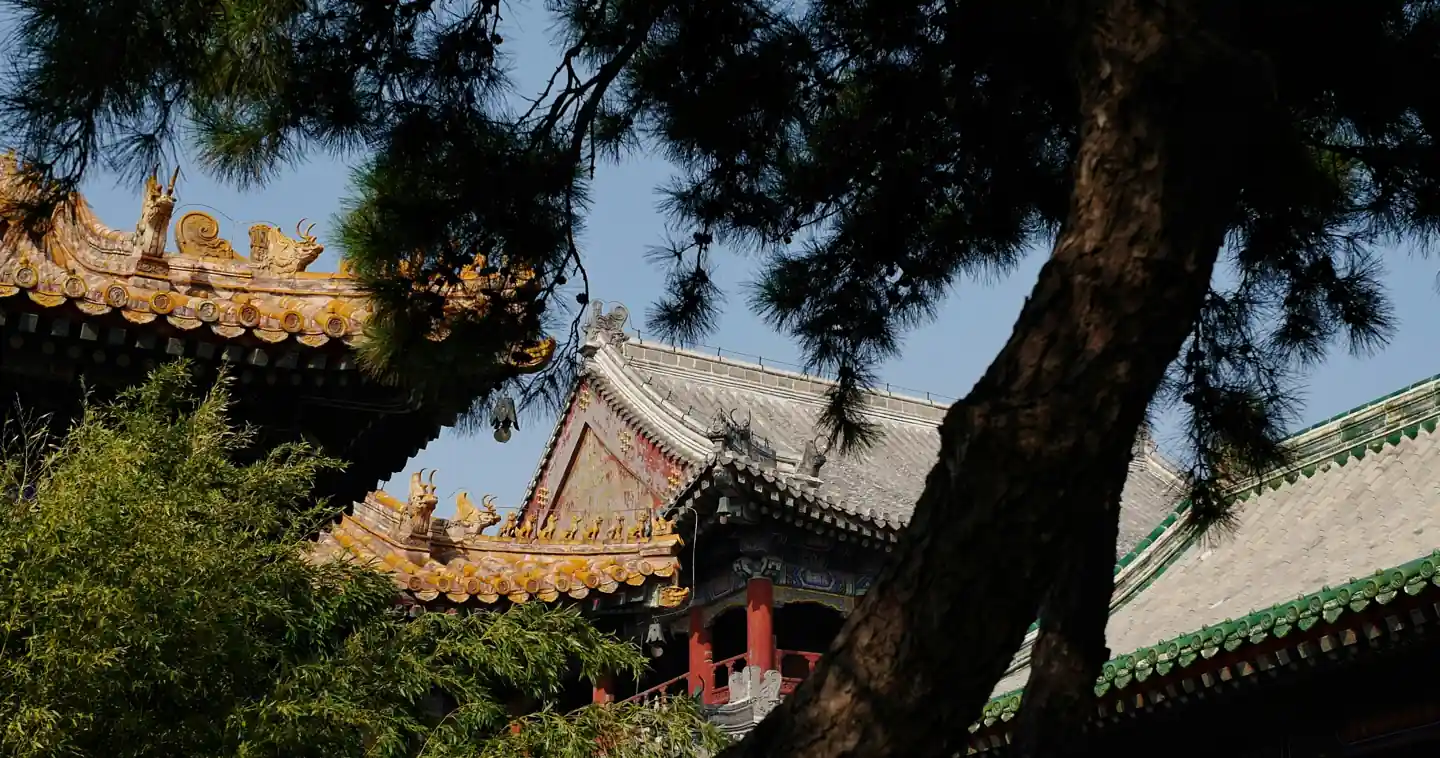
A visit to Beijing’s Lama Temple rewards attention to the spaces between its halls: courtyards, red columns and galleries that connect buildings above ground level. Yonghe Temple, or Yonghegong (雍和宫), is also a Buddhist place of worship. Give the architecture a slow look outside, then put the camera away inside the halls and leave worshippers room to pray.
Courtyards and linked galleries
The courtyards make the temple’s layers easier to read. A doorway frames another building, an upper gallery joins neighboring structures, and roof edges overlap above the open space. I’d pause where those connections are visible before moving through the next entrance. The interest lies in how the buildings meet, as well as in each hall’s facade.
In the courtyard photograph, a covered bridge crosses between upper galleries while the nearer eaves cut diagonally across the view. Red pillars continue from the ground to the upper level. Following one of those lines with your eyes helps separate the foreground building from the roof and balcony behind it.
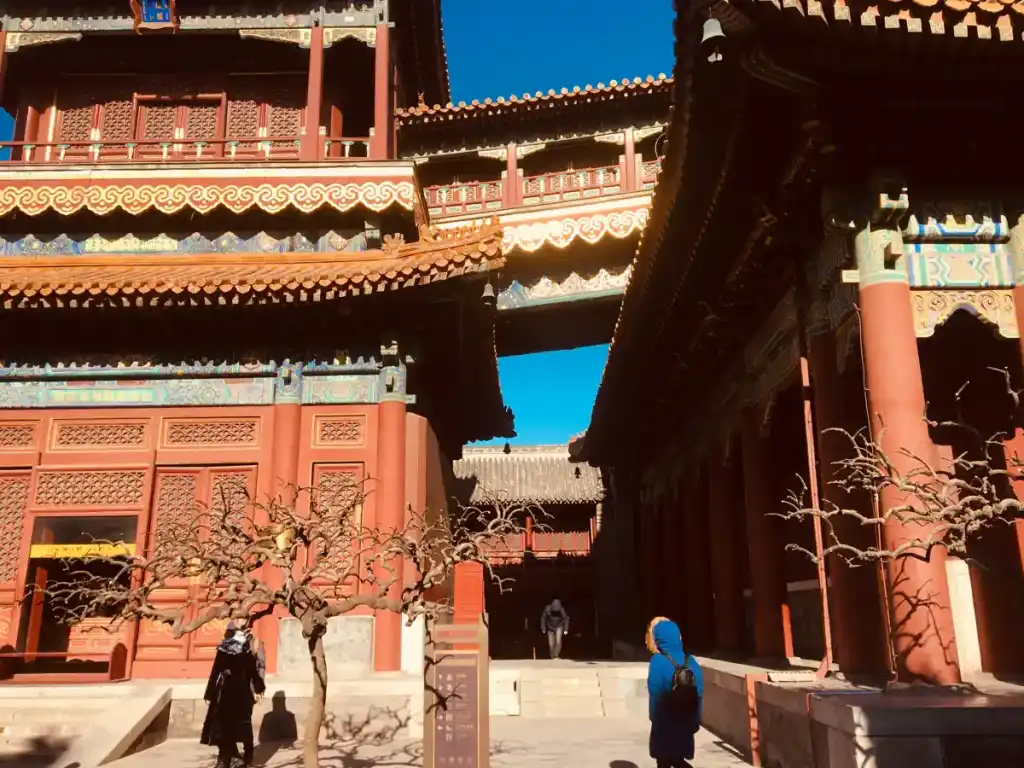
The small vertical sign in this courtyard reads 顶礼佛法僧: “Pay homage to the Buddha, the Dharma and the Sangha.” Dharma refers to Buddhist teaching; Sangha refers to the Buddhist community. The sign is a reminder that these courtyards belong to a religious setting, even when the architecture has caught your attention first.
Beijing’s tourism portal dates the original princely residence to 1694 and its conversion into a Buddhist monastery to 1744. That change of use gives the palace-like setting some context. For other kinds of historic spaces, the Beijing destination collection brings together the site’s city articles.
Buddhist art inside the Lama Temple halls
Beyond the courtyard architecture, the halls ask for closer attention to religious objects and their setting. Beijing’s tourism portal identifies the large Maitreya figure in Wanfuge, the Pavilion of Ten Thousand Happinesses. Maitreya is the future Buddha in Buddhist tradition; knowing the name gives the figure a meaning beyond its scale.
I’d use the hall’s own labels to identify individual figures before assigning a meaning to a hand gesture or an object. Similar-looking details can belong to different figures. Read what is available, take time to see the arrangement, and let an uncertain identification remain uncertain rather than fitting every image into the same story.
The temple’s published visitor notice prohibits photography and filming inside halls, as well as incense burning there. Keep the camera away even when a doorway offers a view of a statue. Outside, leave a clear path for people approaching an entrance and ask before taking a close photograph of someone at worship.
The distinction from another Beijing landmark matters here: the Temple of Heaven is an imperial ritual complex with its own park and monument tickets. Its ticket coverage and opening hours belong to a separate visit; don’t apply those admission arrangements to Yonghe Temple.
Lama Temple hours and tickets to check before setting out
Seeing the halls depends on arriving with usable visiting time. The Beijing municipal government’s published schedule distinguishes closing time from the earlier ticket-sales cutoff. All times below are Beijing time; temporary notices and holiday arrangements can change the regular schedule.
| Season | Published opening hours | Ticket sales stop |
|---|---|---|
| April 1–October 31 | 9 a.m.–5 p.m. | 4:30 p.m. |
| November 1–March 31 | 9 a.m.–4:30 p.m. | 4 p.m. |
The tourism portal lists standard admission at CNY 25. Treat that as a published reference price and confirm the actual ticket, date and eligibility in the temple’s current official channel. The government’s Yonghe Temple visitor information names an official WeChat reservation channel and lists the address as No. 12 Yonghegong Street, Dongcheng District.
Passport booking instructions need a current check. The temple’s older indexed ticket page describes different handling for full-price online orders and reduced-price passport tickets, but I couldn’t reopen that page to confirm its present application. Before paying, ask the official channel which product accepts your document, what original documents are needed and how entry is confirmed.
I would settle those questions before choosing the rest of the day. Reaching the area just before ticket sales end leaves little room for a problem with an order, and little time to examine the buildings once inside. For a day built around a palace reservation or a lakeside walk instead, compare the separate Beijing one-day itinerary options.
After the temple: leave room for Beijing’s streets
Once the temple visit is finished, a street walk changes the scale of the outing. Choose the area and the return journey before adding another ticketed stop. The Bell Tower and Dashilan hutong walks describe two separate routes with named starts and finishes; neither should be treated as directions from the Lama Temple gate.
For a visit focused on Yonghe Temple, the useful sequence is simple: resolve admission, spend time with the courtyards, and give the halls attention without photographing their interiors. Keep any later outing flexible enough that the temple doesn’t become a hurried passage between other stops. More destination choices are collected at China Culture Way.
Featured image explanation: The photograph shows layered roofs and red columns behind branches at Yonghe Temple; the delivered image was cropped vertically, resized and compressed as described in its credit.
Photo credits
Photo: Yueqing Xiao / Unsplash / Unsplash License. Cropped vertically from 3129×1759 to 3129×1647 (box 0,56,3129,1703), resized to 1440×758, and compressed to WebP.
Explore the Beijing city guide →