Beijing Confucius Temple and the Imperial College reward a visit together because they show different sides of imperial learning: honoring Confucius at the temple, and organizing education at the college. Give Dacheng Hall and the temple’s stone inscriptions your attention, then turn to the college’s glazed archway and Biyong Hall. The change in purpose makes the neighboring compounds easier to understand.
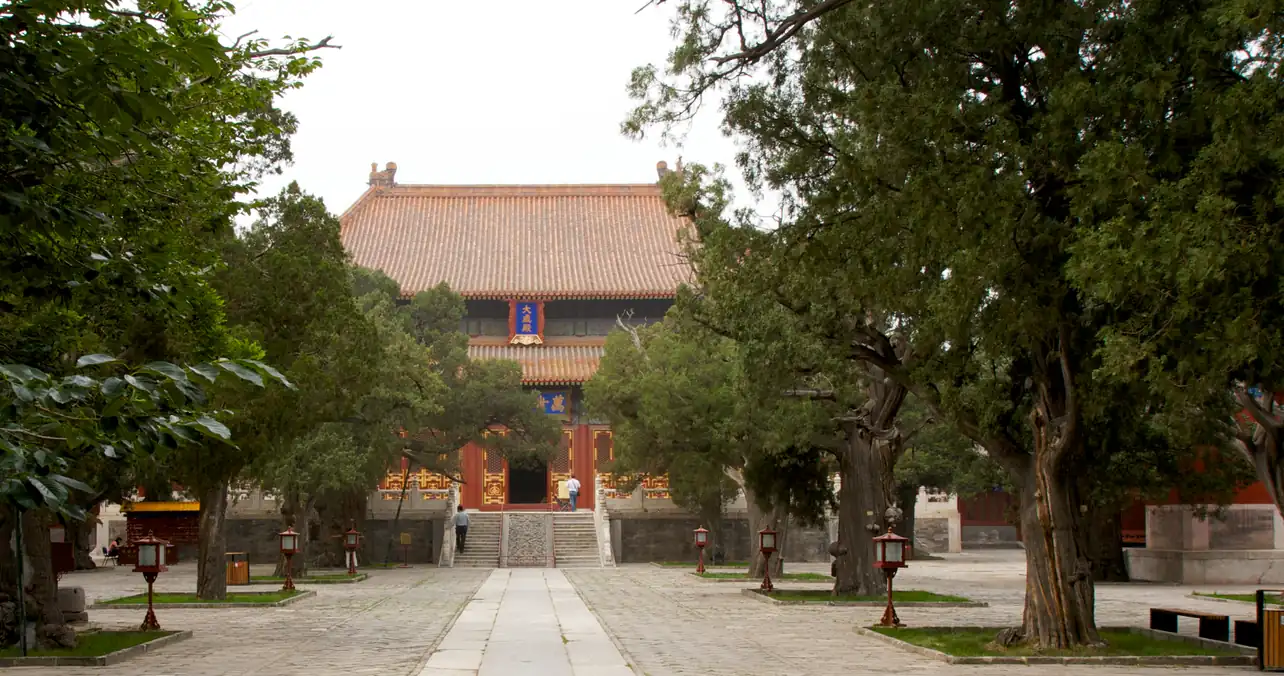
Featured image explanation: Dacheng Hall stands beyond the tree-lined courtyard at Beijing Confucius Temple. The central plaque reads Dacheng Hall, or Hall of Great Accomplishment. This photo shows the temple building used for the page’s preview image.
Confucius Temple: Dacheng Hall and the stone inscriptions
Start with the temple’s purpose. Emperors held ceremonies honoring Confucius here, and Dacheng Hall was the main building in that ceremonial setting. Confucius was the teacher and thinker whose teachings held a central place in imperial education. Knowing that connection helps explain why a place of worship stands beside a state college.
Dacheng means Great Accomplishment.
Keep the name handy. Several courtyards and gates can blur together on a visitor map. I’d make this the temple’s main pause, then give the carved texts a separate look rather than moving straight on to the next large roof.
The stone inscriptions connect the buildings to people and texts. The Beijing cultural heritage authority describes tablets recording successful candidates in the imperial examinations, alongside stone inscriptions of the Confucian classics. A list of names and a text carved in stone do different jobs: one records achievement, while the other preserves the writings studied and valued within that educational world.
You don’t need to read Chinese to tell those apart. Check the display labels to see whether you’re looking at an exam record or a classical text. Then notice how the words are arranged and how much stone the writing occupies. The photos here don’t provide close views of those inscriptions, so use the on-site labels for each object.
Browse the Beijing destination collection when choosing which other sights belong in the day. Keep the temple and college together as a focused stop if the relationship between buildings and education is what interests you.
Biyong Hall at the Imperial College
The neighboring Imperial College, or Guozijian (国子监), shifts the subject from honoring the teacher to the state’s schools. It served as the highest educational institution and an education administration body during the Yuan, Ming and Qing dynasties. The glazed archway and Biyong Hall are useful landmarks for this part of the visit.
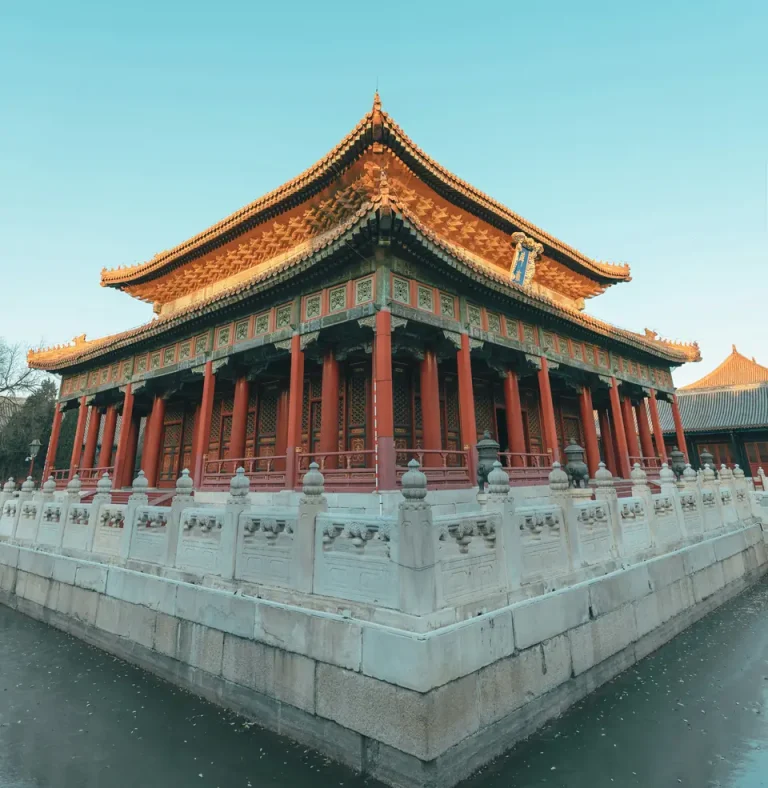
Biyong needs a little explanation. The cultural heritage authority identifies the hall as a place where the Qianlong emperor gave lectures. Treating it as an ordinary classroom would miss that imperial role. I’d approach it with that distinction in mind: this is a building associated with an emperor teaching, within the larger college setting.
The photo shows the hall’s red columns, layered roof and surrounding stone balustrades. The blue plaque names the hall Biyong. Compare that enclosed space with the approach to Dacheng Hall in the temple. The buildings’ uses supply the comparison; roof color alone won’t tell you what happened inside.
Look for the glazed archway as another college landmark, but use the current visitor map to find the open route. I haven’t verified the present internal passage between the compounds or whether visitors can move back and forth. The temple-first, college-second order here is an editorial way to follow the subject, rather than a confirmed sequence of gates.
Tickets, opening hours and the 13–15 Guozijian Street address
Before committing to that order, settle admission for your date. Beijing’s official English page dated November 9, 2026 publishes an adult ticket price of CNY 30, opening hours of 9 a.m.–5 p.m. and last entry at 4:30 p.m., all Beijing time. It lists Monday closure except during holidays. Check temporary notices and holiday arrangements before leaving.
Save the Chinese institution name 孔庙和国子监博物馆 along with Guozijian Street (国子监街). Official pages differ on the street number: the November 2026 English page gives No. 15, while the September 2024 ticketing page gives No. 13. The cultural heritage authority’s institution listing gives Nos. 13–15. That range helps locate the institution, but it doesn’t identify today’s visitor entrance.
Reopen the Beijing government visitor page to check the published hours and price. The older ticketing page describes online and ticket-office purchasing, but it doesn’t establish the current procedure for a foreign passport.
Ask the museum which entrance to use, how to buy with your travel document and whether advance booking is required for your date. Also confirm what the ticket covers and which connection between the compounds is open. Those answers are still unverified for this guide. A published adult price alone doesn’t settle passport registration or access between the two sites.
Give the two compounds room in a Beijing day
Once entry is confirmed, I’d leave roughly one and a half to two hours for the temple and college, adding travel and any ticket queue separately. That’s an editorial planning allowance, not a measured visit time or official recommendation. Reading inscriptions closely can take longer, while a visit centered on the main buildings may use less time.
Keep the sequence simple: temple hall and inscriptions, then college archway and Biyong Hall, following the actual open visitor route. If time runs short, choose a main building in each compound before trying to read every label. The aim is to leave with the difference between the two institutions clear.
This visit would change the balance of the site’s Beijing one-day itinerary, which offers a palace day or a Drum Tower–Shichahai walk. I’d give the temple and college their own block by shortening another visit. Adding them to the full palace route would reduce the time available for both.
If public lanes are the main attraction instead, the self-guided Beijing hutong walks describe separate Bell Tower and Dashilan outings. Those street routes have their own starts and finishes; neither supplies directions through this museum. For the temple and college, save the confirmed entrance and ticket instructions before setting out.
Written by Alex Chen, founder and editor of China Culture Way.
Photo credits
Photo: LuxTonnerre / Wikimedia Commons / CC BY 2.0. Cropped to a wide view, resized and compressed as WebP.

Explore the Beijing city guide →