
Foreign visitors can use Alipay for everyday purchases in mainland China by registering an account and linking an eligible overseas bank card. A Chinese bank account isn’t required for that route, and registration can use an overseas phone number. Getting the account open, linking the card and completing a particular payment are separate checks. I’d prepare the first two before departure, with another way to pay available on arrival.
Register Alipay, then link an eligible foreign card
Start with a phone number you can continue using during the trip and a card you want to charge for purchases. China’s multi-agency guide for overseas visitors allows registration with a foreign or Chinese mobile number. You don’t need to buy a Chinese SIM simply to meet a supposed Chinese-number requirement for Alipay.
The official Alipay visitor guide describes this setup sequence:
- Download Alipay, enter your mobile number and follow the registration prompts.
- Choose the International Version after signing up, if offered in the setup flow.
- Use the add-card prompt and enter the details requested to link an eligible bank card.
Follow any verification request shown for your account or card. American Express’s Alipay FAQ describes passport-information checks when identity verification is required; it doesn’t establish that every visitor must complete an identical passport screen before any purchase. Use the requirements on your own account rather than a screenshot from someone else’s phone.
The card issuer must verify the binding, according to the multi-agency guide. A card network’s logo alone doesn’t tell you that your particular card will work. I wouldn’t leave a rejected card to sort out at the first restaurant: ask the issuer or Alipay what prevented it from linking.
For the connection itself, our China SIM and eSIM guide separates local-number needs, handset checks and plan terms. Keep phone and payment preparations together using the China travel tips overview.
Scan a merchant’s QR code or show your Alipay payment code
Once the card is linked, the checkout determines which way the code is read. Shanghai’s official payment guide describes these alternatives:
- You scan: open Alipay’s Scan function, scan the merchant’s payment code, enter the amount if required and confirm the payment.
- The cashier scans: open your payment code and present it to the cashier’s reader.
I’d ask the cashier which method to use if the counter has several signs or devices. A payment logo is useful for recognizing the service; it doesn’t confirm that every foreign card or every function in the app is accepted.
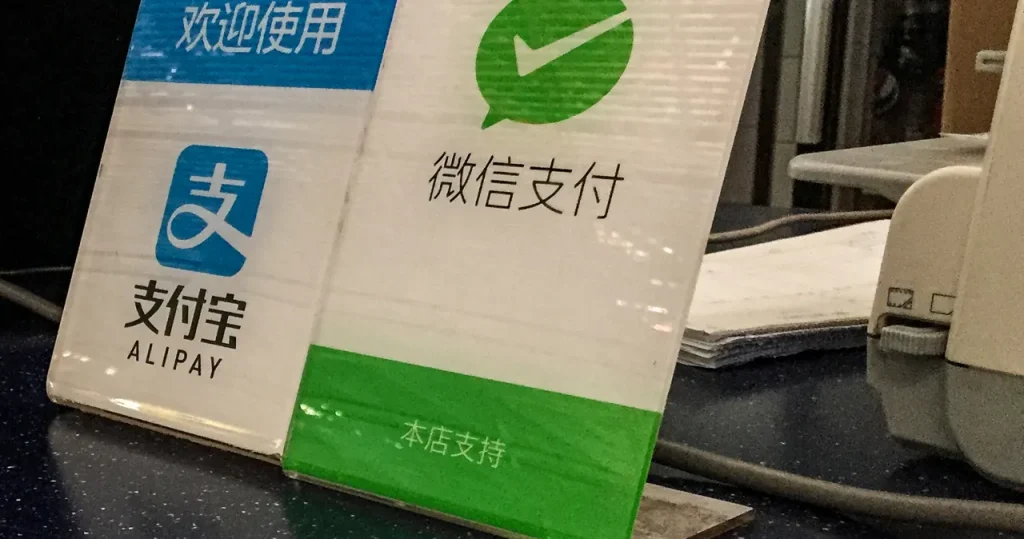
Photo credits
The labels say Alipay, WeChat Pay, Welcome and Supported here. This historical photo does not establish current card acceptance.
Photo: N509FZ / Wikimedia Commons / CC BY-SA 4.0. Cropped to a 1.90:1 landscape frame (x=1500, y=550, width=1764, height=930 from the 3264 × 2278 original), resized to 1280 × 674, and compressed as WebP. No retouching. Derivative under CC BY-SA 4.0.
At a shared meal, deciding who pays is a separate conversation from how the app works. The Chinese table manners guide covers agreeing whether you’re hosting or splitting the bill before ordering.
Read the foreign-card fee before confirming payment
The published standard rule for linked overseas-card payments is a platform service-fee waiver for a single transaction of CNY 200 or less, and a 3% service fee on the whole transaction when its amount exceeds that threshold. China’s 2024 guide states that rule; American Express’s February 2025 Alipay FAQ also states the 3% charge for transactions greater than CNY 200.
Treat those published terms as a baseline, then read the charge displayed for the actual payment. The 2025 multi-agency guide specifically says charging standards can vary by payment product and directs users to the product page and service agreement. Don’t assume that a promotion, another wallet’s offer or an old article applies to your card today.
Currency conversion is another part of the cost. Alipay’s visitor FAQ says the card network and issuing bank provide the exchange rate for international-card transactions, and directs users to the card statement. I’d check my issuer’s foreign-transaction charges as well, rather than treating a waived platform fee as a promise of a cost-free purchase.
Foreign-card payments don’t unlock every Alipay function
Paying a merchant with a linked foreign card doesn’t give the account every function visible in Alipay. Its visitor FAQ excludes person-to-person transfers, sending or receiving red packets, wealth management, insurance and other financial services from international-card use. A red packet is a digital cash gift, often called hongbao (红包).
That distinction matters when settling up with a friend. Don’t assume a card that paid a restaurant can fund a transfer to your companion. I’d agree how to share the bill before ordering, rather than promise to repay through an app function I haven’t established I can use.
Spending limits also need the account’s own terms. Shanghai’s September 2026 guide gives maximums of USD 5,000 per transaction and USD 50,000 per year for overseas visitors using linked international cards. Those published ceilings aren’t a promise that your account or issuing bank will approve a payment of that size. Check the limit and verification status displayed for your account before relying on a large purchase.
When Alipay rejects a card, payment or refund request
The useful starting point is where the problem occurred. A failure to add a card needs a different conversation from a refund on a completed restaurant payment.
| What happened | Where I’d start |
|---|---|
| The card won’t link | Read the binding error and contact Alipay or the issuing bank; the official guide says issuer verification is part of linking. |
| The app requests identity details | Follow the account’s verification prompt, without assuming that registration alone completed every check. |
| A purchase fails | Keep the exact error and order details for support; don’t infer the reason from another traveler’s experience. |
| A completed purchase needs a refund | Contact the merchant with the transaction details. A failed payment and a refund are different cases. |
American Express’s Alipay FAQ describes finding help through Me/Account and Help Center. For a refund, it directs customers to the merchant and explains using the transaction record to contact the payee. I’d keep the purchase identifiable while asking for help, without assuming a refund is automatic or immediate.
Alipay’s published overseas customer-service number is +86 571 2688 6000, with service hours of 08:00–24:00 China time, every day. Carrier charges can apply to the call.
Keep another payment option with your travel essentials
An Alipay account is one preparation, not a reason to travel with only a phone. China’s official payment guidance also provides for physical bank cards and renminbi cash. Check for your card network’s logo when looking for a card terminal or cash-withdrawal ATM.
My arrival checklist would include a working phone connection, a linked card, the physical card and some cash. I’d keep the accommodation details with those essentials, so an app problem doesn’t also leave me trying to recover the address.
For a rail journey, check passenger verification and ticket confirmation in the China train ticket booking guide. For choosing the places around those bookings, start with the destination collections on China Culture Way.
Photo credits
Photo: HualinXMN / Wikimedia Commons / CC BY-SA 4.0. Cropped to a 1.90:1 landscape frame (x=2100, y=400, width=2000, height=1052 from the 4100 × 2393 original), resized to 1280 × 674, and compressed as WebP. No retouching. Derivative under CC BY-SA 4.0.
