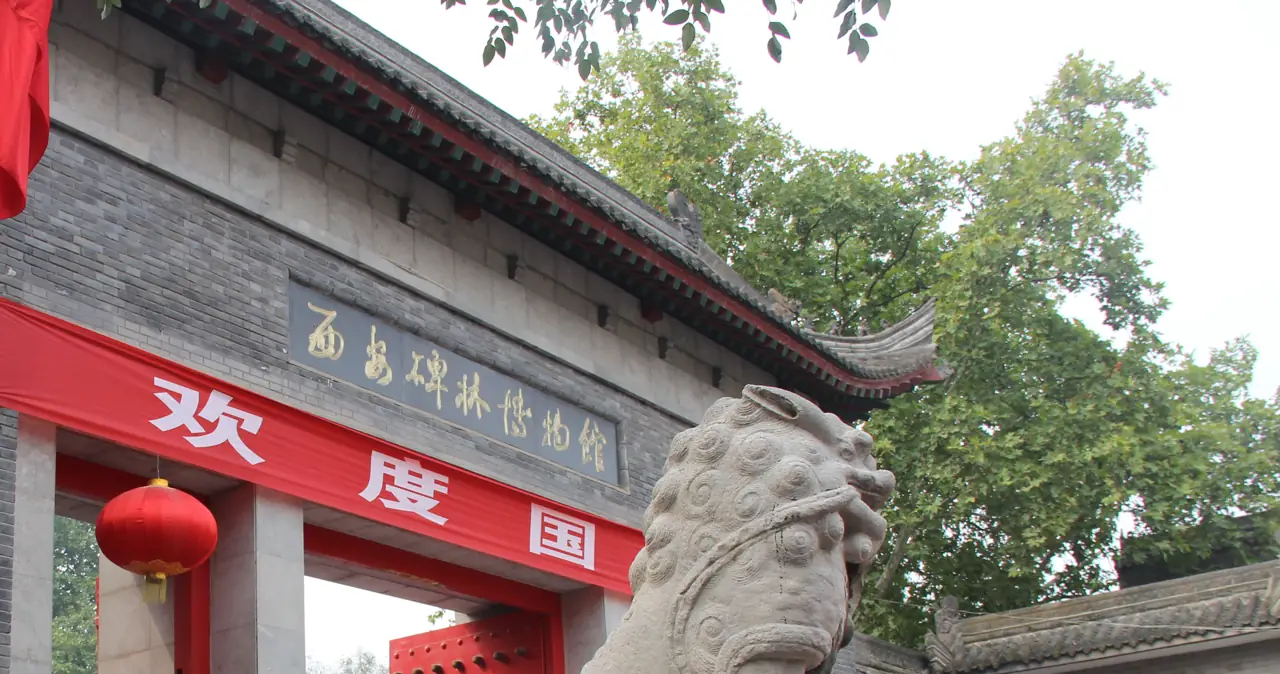
Xi’an Beilin Museum turns written words into objects you can walk around: stone slabs carry texts and calligraphy, while sculpture gives the visit another way into the collection. You don’t need to read Chinese to enjoy the shapes of the characters or the carved figures. Plan for the historic courtyards and the newer north hall together, then choose where to linger according to your interest in writing or sculpture.
Start with the old courtyards
The museum’s historic setting includes Xi’an’s Confucian Temple buildings. The official visitor guide describes a complex retaining the scale and landmark structures of a Ming and Qing temple, including gates, a screen wall and a ceremonial pool. Those spaces give the inscribed stones an architectural setting as well as a place in a display.
The pavilion photograph shows how that setting looks: layered roofs sit above red columns, with trees around the building. Its plaque reads 碑林, Beilin, meaning “forest of steles.” A stele is an upright stone bearing an inscription. The name becomes much easier to remember once the idea of many standing texts replaces the image of an ordinary forest.


The photograph illustrates the courtyard architecture; it doesn’t identify a particular inscribed stone or the route through today’s exhibitions. Use the current museum map to connect the old buildings with the displays you want to see.
For the wider setting, the Xi’an destination guide brings together the city’s main cultural stops. Beilin rewards a closer look at writing and carving within that broader visit.
Reading stone steles without reading every character
Inside the historic exhibition rooms, writing becomes the main subject. The museum’s guide lists the Kaicheng Stone Classics, carved texts of Mencius, pictures and calligraphic inscriptions among the courtyard displays. The Kaicheng Stone Classics put classical texts onto stone, so they offer a useful starting point for thinking about a text as a physical object.
I’d approach a stele at two scales. From farther back, the arrangement of the writing creates a surface of columns, gaps and repeated marks. Closer viewing brings out the shape of a character and the space around it. You can notice whether the strokes look tightly gathered or widely spread before knowing what the words say.
For me, that’s a less tiring aim than trying to decode each line. Pick a stone that catches your eye, read the label for its subject and context, then return to the carved surface. The label supplies meaning; the stone lets you see how that meaning has been given form.
The museum’s website still describes historic rooms numbered one through seven, but that description isn’t a reliable room-by-room treasure hunt. Exhibition arrangements can change, especially with the newer building in use. Ask where a particular inscription is displayed if seeing it is central to your visit.
Give the stone sculpture its own attention
Writing isn’t the collection’s only visual language. The Stone Carving Art Gallery focuses on Buddhist images in its “长安佛韵” exhibition, while the Xi’an Stone Carving Art Room presents a different group of works under “石艺撷珍.” The latter includes Han and Tang stone carving, from pictorial stones to tomb sculpture and stone burial furnishings, according to the museum’s guide.
That distinction helps when you begin to tire of written surfaces. Buddhist figures invite attention to faces, posture and drapery. Pictorial stones and carved burial objects draw the eye toward scenes, borders and the relationship between decoration and the object’s shape. Let the labels establish what an object was for before drawing conclusions from its appearance.
I’d keep some time for sculpture even on a calligraphy-focused visit. Comparing an incised written surface with a carved figure changes what you notice about depth and shadow. For someone less drawn to scripts, the sculpture can be the part of Beilin around which the rest of the visit is arranged.
Beilin’s focus is different from a broad regional history display. If that broader introduction is what you want, the Shaanxi History Museum guide explains its main museum and Qin-Han branch, along with their separate booking arrangements.
Include the north hall when choosing what to see
The older courtyards are only part of the museum described in its current guide. The north hall opened in May 2025, adding a substantial new exhibition building to the historic site. The museum lists displays there concerned with Chinese characters, calligraphy, inscriptions and other parts of its stone collections.
A plan based entirely on an old account of the courtyard rooms can therefore miss a large part of the visit, particularly if the display that interests you has moved into a new space. I’d use the arrival map to locate the writing and sculpture displays that matter most, including those in the north hall, before spending all my attention in the first building.
Think of the courtyards and the new hall as different settings for the collection. The courtyard architecture makes the historic surroundings part of what you see; the north hall expands the exhibition choices. The map and that day’s open areas should determine the walking order.
If temple architecture becomes a stronger interest than stone collections, the Giant Wild Goose Pagoda guide separates an outside view from entering Daci’en Temple. That’s a different visit to weigh against the time you want to spend with Beilin’s displays.
Match the museum entrance to the current instructions
Once the collection fits your plans, settle the entry details. The official guide gives the older address as 15 Sanxue Street (三学街15号) and also lists a north gate at 44 Dongmutoushi (东木头市44号). Check the entrance named in your booking or current museum instructions against your map destination. The existence of both addresses doesn’t establish that both gates will admit visitors on your day.
For tickets and opening hours, consult the Beilin Museum official visitor guide and the museum’s latest dated notices. When checked on November 15, 2026, the website contained inconsistent visitor information, including an older temporary notice and an exhibition entry whose stated end date had passed. Confirm the current price, last admission and open areas before committing to an arrival time.
Passport booking needs a separate enquiry. I haven’t verified the live purchase form or a passport-holder’s admission procedure. Ask the museum which booking channel accepts your document and where to present it; the visitor guide lists the enquiry number as 029-87253331. Keep the museum’s answer with your booking details.
The guide also says not to touch the objects and prohibits flash photography. Follow the signs in each exhibition space for any further photography restrictions.
For a second old-city activity, the Xi’an City Wall guide covers its gates, walking and cycling. Confirm the museum’s entry arrangements before giving the wall a fixed place afterward. More destinations and cultural background are collected on China Culture Way.
Featured image explanation: The historical photograph shows the museum’s older gateway, its name plaque and part of a red festive banner. The plaque says “Xi’an Beilin Museum.” The photograph provides an architectural reference rather than current entrance or ticketing instructions.
Photo credits
Photo: Gary Todd from Xinzheng, China / Wikimedia Commons / CC0 1.0. Cropped to the upper gateway architecture and lion to exclude nearby visitors and the traffic area; resized and compressed to WebP. Original image and derivative dedicated under CC0 1.0.

Explore the Xi’an city guide →