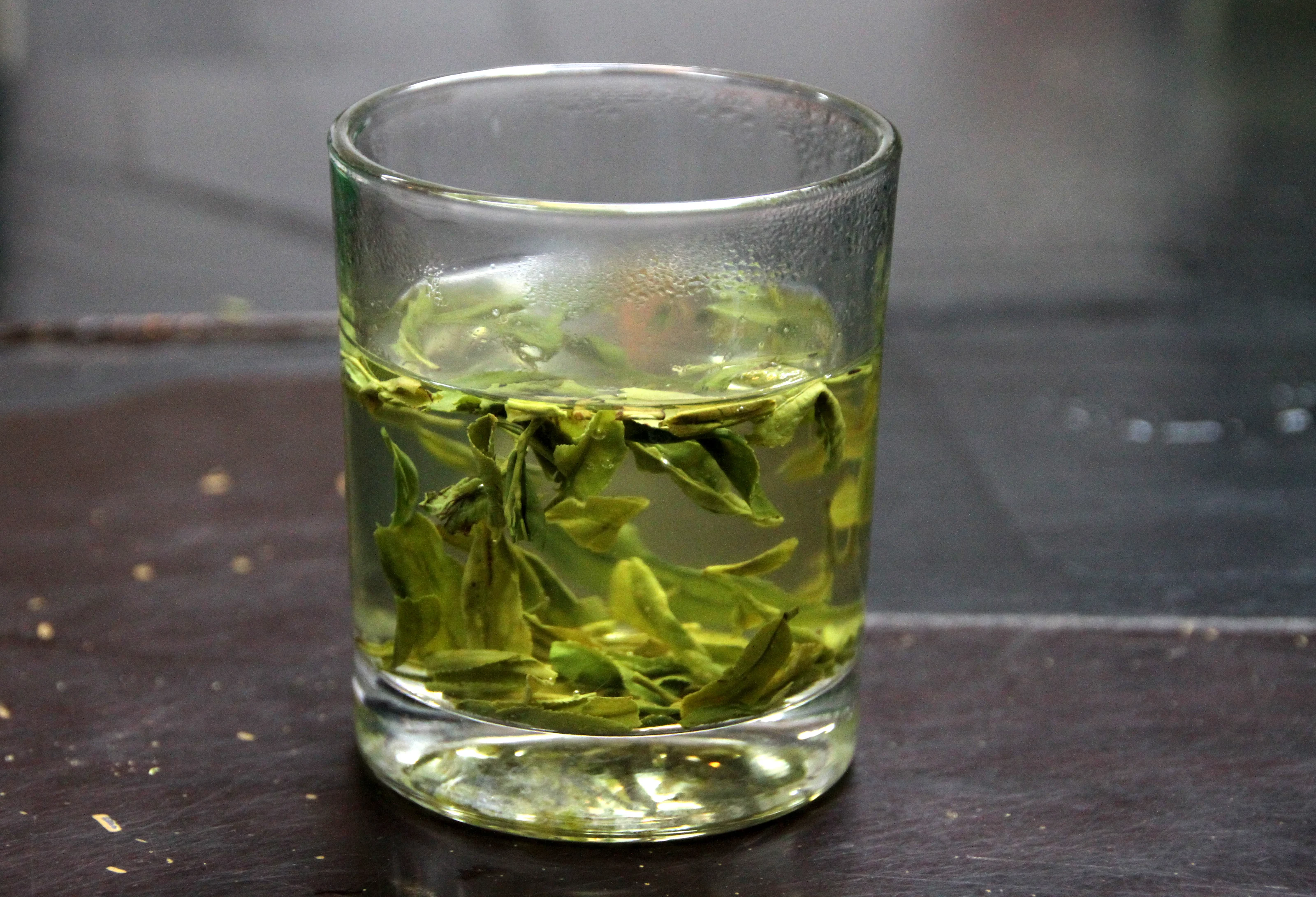
Tea etiquette in China starts with acknowledging the person serving: accept an offered cup with care, say thank you, and follow the host’s lead when tea is shared. At a Cantonese tea table, light finger tapping can also express thanks. The useful distinction is between joining someone’s hospitality and performing a formal tea service; an ordinary invitation doesn’t require mastering the latter.
When a host offers tea, acknowledge the welcome
An offered cup gives a visitor a simple way to respond to hospitality. China Culture’s introduction to serving guests tea describes courtesy without necessarily following strict formalities. That leaves room to ask questions, enjoy the conversation and learn how this particular host likes to serve.
If someone hands over a cup, receiving it with both hands is a considerate gesture, especially in a more formal setting. If the cup is placed on the table, a spoken thank-you acknowledges the same care without requiring a handover. Let the server finish pouring before moving the cup; reaching toward a cup while it is being filled makes the exchange needlessly awkward.
A smile and “thank you” work well. In Mandarin, xiexie (谢谢) means “thank you.” I’d learn that phrase before trying to remember a detailed set of hand signals: it works whether tea arrives in a small cup, a drinking glass or a mug.
The wider Chinese tea culture introduction connects drinking tea with places and traditions; this page concerns how to join the table in front of you.
Finger tapping says thank you at a Cantonese tea table
The hand signal worth recognizing is a light tap on the tabletop when someone pours tea. South China University of Technology’s guide for international scholars describes this expression of gratitude in its section on Cantonese morning tea. Cantonese here refers to the tradition associated with Guangdong in southern China.
The index and middle fingers can make the gesture beside the cup. Tap the table lightly rather than the cup itself. Treat the gesture as something to recognize and join when others use it, rather than a test to apply at every tea table across China.
Don’t let a missed tap become a larger interruption than the original moment. If a conversation moves on before the gesture occurs to you, say thanks when there’s a natural pause. Gratitude remains the point; I’d put the conversation ahead of demonstrating a custom perfectly.
Pour for others before filling your own cup
Once the teapot comes within reach, the question changes from receiving hospitality to sharing it. At a Cantonese morning-tea table, the university guide describes the person holding the pot serving others before themselves. If you’re taking responsibility for the pot, offer tea to the people beside you before filling your own cup.
Leave room below the rim rather than filling a cup until it overflows. For a visitor, there’s little value in trying to measure an exact fraction while pouring. A manageable pour and attention to the other person’s response give more help than treating a familiar saying as a precise serving specification.
When someone else is running a tea session, ask before taking over the pot or adding water. The host may be arranging the next round. A simple “Shall I pour?” settles the question without needing to work out an unwritten hierarchy from everyone’s seats.
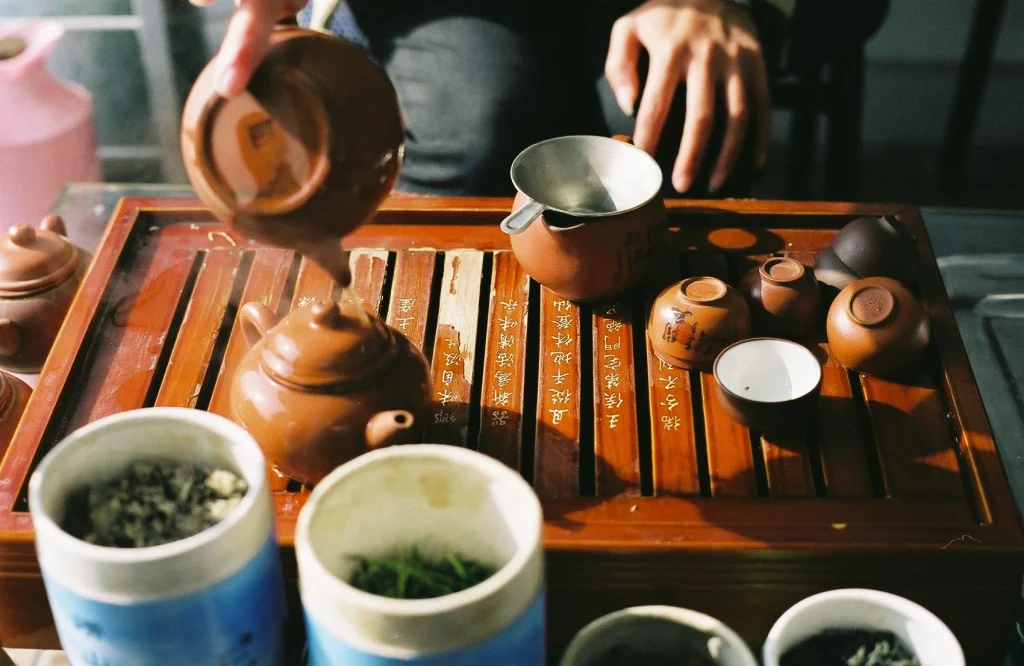
Photo credits

Tea served during dinner sits alongside the rest of the meal. For shared dishes, serving utensils and toasts, the separate Chinese table manners guide covers the decisions beyond the teapot.
Small cups belong to a shared tea session
A pot surrounded by small cups suggests a different pace from ordering a large drink to keep beside you. Gongfu tea (工夫茶) is a careful style of tea preparation associated here with Chaozhou, a city in Guangdong. The university guide describes sharing freshly brewed rounds in small cups, with conversation forming part of the occasion.
As a guest, let the person brewing show which cup is yours and when a round is ready. Asking “Is this ready to drink?” is more useful than guessing the role of every vessel. A set of unfamiliar tea utensils doesn’t oblige a visitor to handle them all.
Sip at a comfortable pace. Smell the tea before the next taste. If you’re curious, ask about something specific: the tea’s name, its aroma or how this round differs from the last. There’s no need to invent a tasting description. “I notice more of the smell than the taste” can start a better conversation than claiming to recognize a flavor you can’t place.
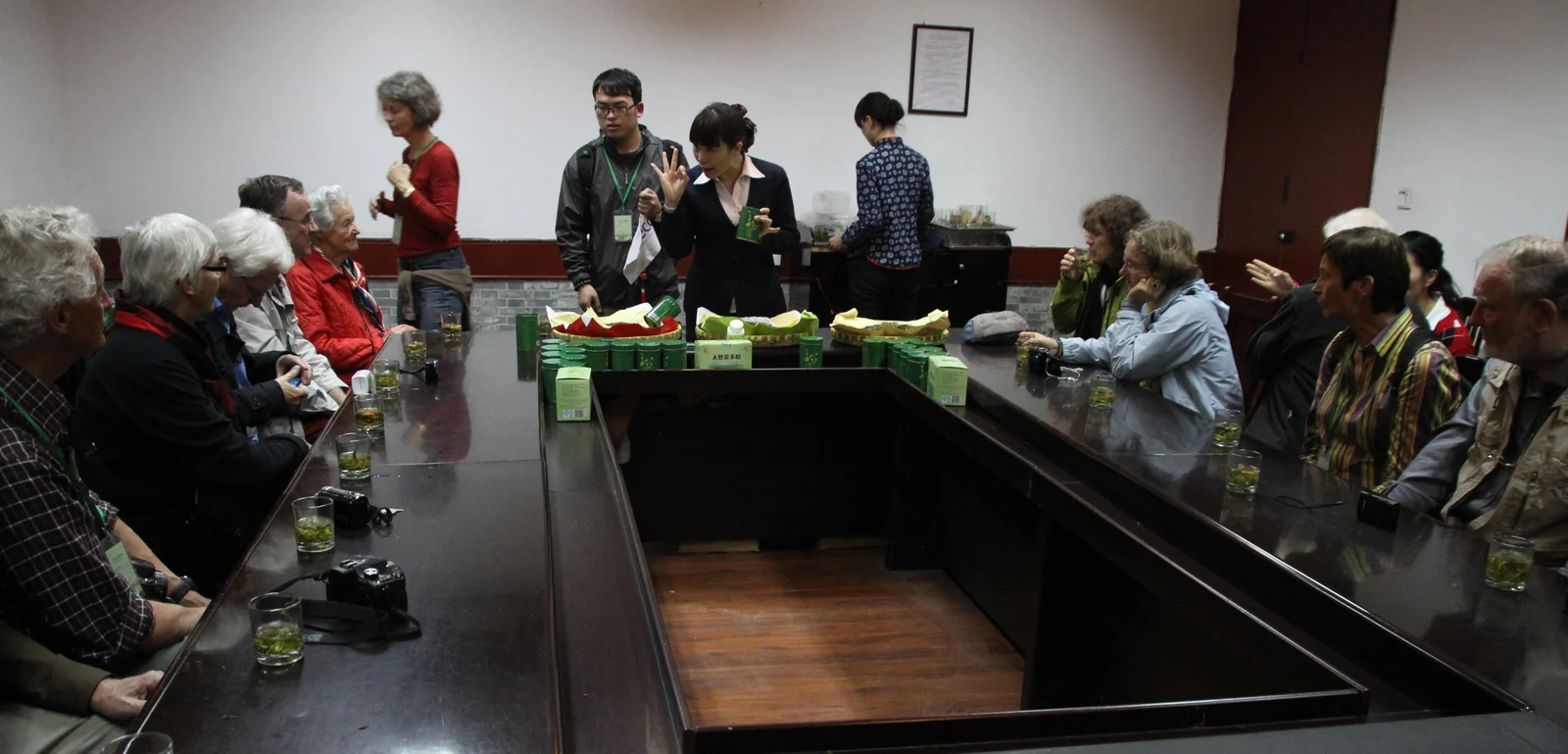
Photo credits

Refills and refusals are easier to explain aloud
Repeated offers can leave a guest wondering what an empty cup is supposed to communicate. I’d use words rather than leave the host to interpret it: “Thank you, I’ve had enough tea,” or “No more for me, please.” Say this before another pour begins, so the server can respond comfortably.
If tea isn’t wanted at all, thank the host for the offer and ask for water instead. A short refusal gives the host a clear preference to work with. No elaborate account of personal taste is needed, and there’s no reason to drink something simply to complete a gesture.
In a commercial teahouse or tea shop, clarify the arrangement before a tasting starts. Ask what the session costs, what the price includes and whether ordering or buying tea is expected. “Is there a charge for this tasting?” makes the distinction between hospitality and a paid experience clear while there’s still time to choose.
Before leaving a hosted tea table, thank the person who prepared the tea. A comment about the tea or something enjoyed in the conversation makes a natural close. Learning the host’s name and listening to the answer about their tea will often matter more than remembering another rule.
Photo credits
Photo: Il lupa / Wikimedia Commons / CC BY-SA 4.0. Center-cropped and encoded as WebP. Derivative under CC BY-SA 4.0.
