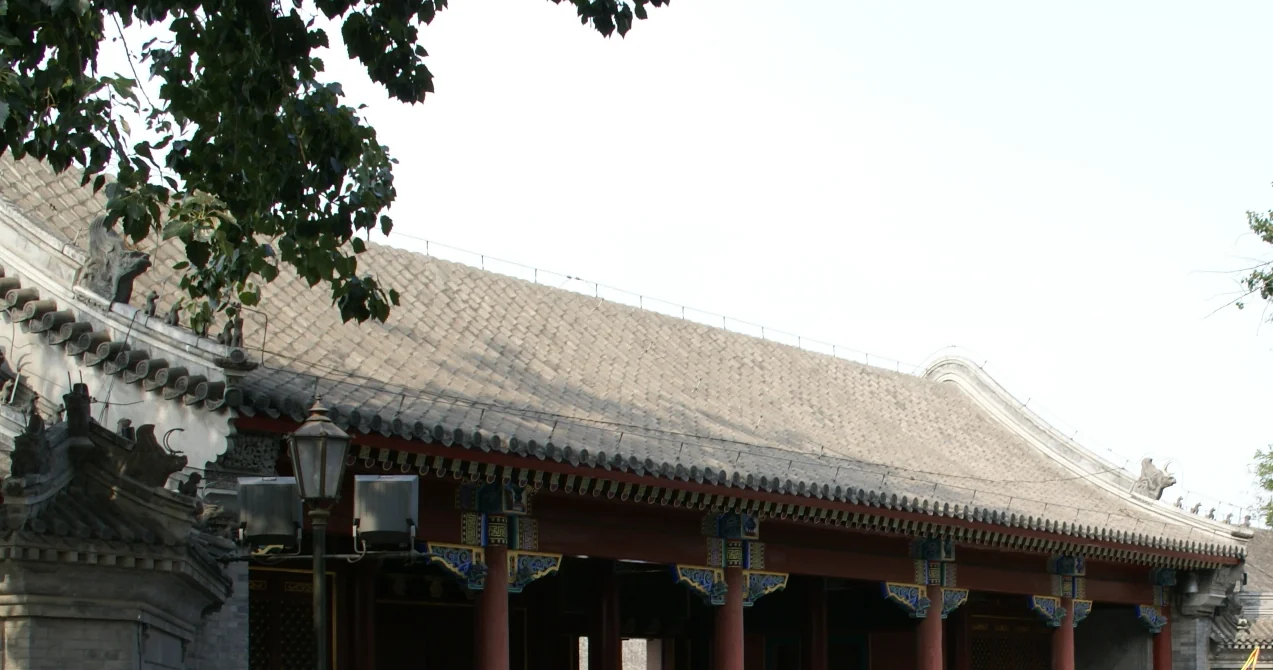
Prince Gong’s Mansion in Beijing combines a courtyard residence with a garden behind it. Give each part a different kind of attention: the residence explains how buildings and courtyards were arranged, while the garden brings ponds, rocks and pavilions into the visit. Also listed as Prince Kung’s Palace and Garden, the complex makes more sense when those spaces have distinct roles. Here’s what to notice in each, then what to check before going.
Read the residence before entering the garden
The residential area has central, eastern and western sections. Beijing’s municipal visitor page places the main gate, the Courtyard of Lions and Yinan Hall (银安殿) in the central section. Those names give you a starting point for understanding the arrangement. They aren’t instructions to walk through every doorway in that order.
I’d begin with the relationship between a courtyard and the buildings around it. From an open visitor area, notice which building faces the space and where the next entrance sits. Then consult the available labels for the building’s name and use. A roofline alone won’t tell you whether a room served daily life, reception or another purpose.
The property’s history also helps separate a princely residence from an emperor’s palace. The Beijing tourism account describes its original owner as Heshen, a favored official of the Qianlong emperor. Prince Gong, a later resident and Qing statesman, supplied the name used today. The change of owner is enough context for a first look; individual halls deserve their own labels rather than the same story attached to every room.
The mansion is one of the historic places collected under Beijing’s city sights. Its residential setting offers a different scale of reading from the imperial palace: spend time understanding a courtyard before moving on to another named attraction.
Decoration offers a closer scale of looking after the broad courtyard layout. The photograph below shows a seated shrine figure, a dragon panel, yellow banners and red hanging tags. It records a detail within the mansion in 2014; use it to notice how an object sits within a decorated setting, without assigning the figure an identity from appearance alone.
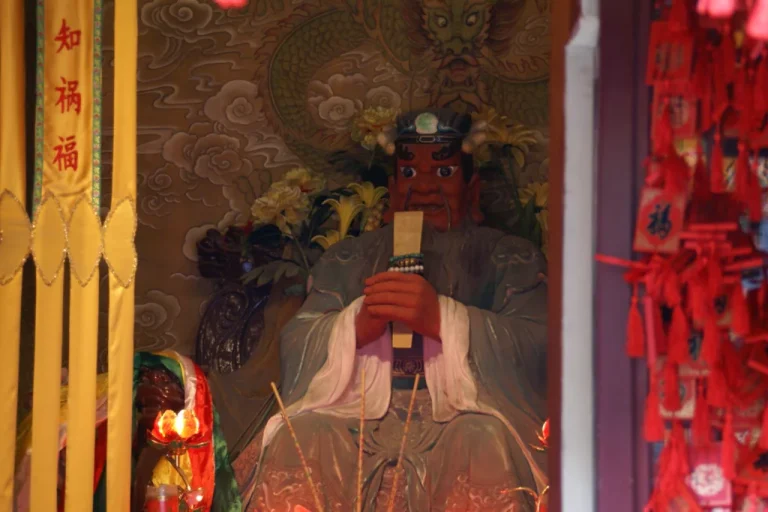

The visible 福 character on the hanging decorations is fu, meaning good fortune. The yellow banner also shows 知, meaning “know,” and 祸, meaning “misfortune.” These are partial visible words, so they don’t establish a complete inscription. The old photograph doesn’t establish today’s display or access either.
Cuijin Garden changes the focus from rooms to scenery
Behind the residential buildings lies Cuijin Garden (萃锦园). The municipal tourism description identifies artificial hills, ponds and pavilions there. After the residence’s courtyard arrangement, the useful question changes: how do the built structures and landscape elements share a view?
For a garden-focused visit, I’d spend less attention collecting room names and more on those relationships. A pavilion can be considered together with the pond or rockwork around it. When a place catches your eye, pause to take in its setting before moving closer to a single carved or painted detail. That’s a way to look, rather than a prescribed route through the grounds.
The older official description also names a Western-style gate, a theater and a stele bearing the character fu. A stele is an inscribed stone monument. Those names can help make sense of the current visitor map, but a historic description of the theater doesn’t confirm a performance on your date. If a particular interior is the reason for coming, confirm its present opening separately.
Architecture and garden scenery can both justify the visit. If courtyards interest you most, give the residence the slower reading and keep the garden as a change of setting. If landscape design is your main interest, leave room to linger behind the residential buildings. There’s no need to give every named feature equal attention.
Prince Gong’s Mansion hours, admission and document checks
Having decided what you want to see, check whether the available visiting window suits it. The Beijing municipal visitor information was published on November 10, 2026, and checked for this guide on November 15, 2026. It lists the following, in Beijing time:
| Item | Published information |
|---|---|
| Address | 17 Qianhai West Street, Xicheng District, Beijing |
| Opening hours | 8 a.m.–5 p.m. |
| Last entry | 4:10 p.m. |
| Weekly closure | Mondays, except statutory holidays |
| Standard adult admission | CNY 40 per person |
Confirm the date’s arrangements through the museum’s official channel before setting out. Last entry is the admission deadline; it doesn’t give a late arrival a full visit. For a short afternoon, consider how much time will remain inside before committing to both parts of the complex.
Passport booking has not been verified for this guide. Before paying, ask the official museum channel which ticket accepts your document, how to reserve for your date and what original identification is required at entry. Resolve any eligibility question there as well, rather than assuming a reduced ticket applies to you.
Give the mansion its own place in a Beijing day
Once admission is settled, fit the mansion into the day as a visit with its own purpose. The relationship between the residence and its rear garden deserves time that would otherwise go to another stop. Keep some space in the day to look closely at the part that interests you.
For a wider day outdoors, the separate Drum Tower–Shichahai itinerary describes a lakeside outing. Adding the mansion means taking time from that walk. Choose which part of the day deserves the attention before adding another stop, especially when museum admission has a fixed deadline.
At the mansion, let the current map and open areas determine the actual path. Keep the residence and Cuijin Garden visible in your plan, then spend the longer pause in the part that brought you here.
Photo credits
Photo: Hermann Luyken / Wikimedia Commons / CC0 1.0. Cropped to the upper-left entrance architecture to exclude identifiable visitors; resized and compressed to WebP. Original image and derivative dedicated under CC0 1.0.

Explore the Beijing city guide →