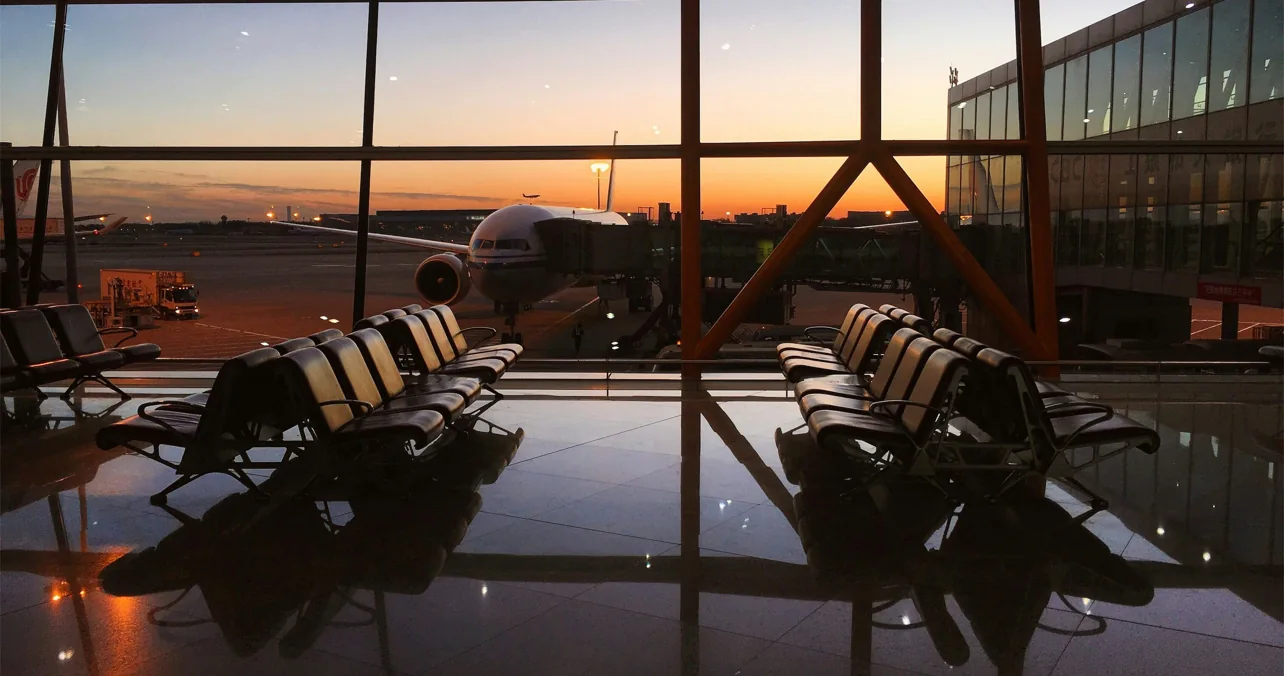
From Beijing Capital Airport (PEK), take the Airport Express if its city connections fit your hotel and you can manage the onward journey with your bags. I’d lean toward a regular taxi for heavy luggage or an awkward transfer, especially after rail service ends. Compare the trip to your hotel’s door before choosing; reaching a city station still leaves part of the journey.
Featured image explanation: The source identifies this terminal-window photograph as Beijing International Airport in 2018. The seats and aircraft provide airport context; the exact terminal is unconfirmed, and the photograph cannot locate today’s transport services.
Before choosing your ride
Check that your booking says Beijing Capital Airport, with the code PEK. Beijing Daxing, coded PKX, has its own transport services. For a PEK arrival, keep your terminal and your hotel’s full Chinese address together, including the branch name if the hotel has several locations.
After a flight from abroad, assess the train option after arrival formalities and baggage collection. A flight’s landing time doesn’t tell you when you’ll reach the railway platform. The queue belt in the photograph below belongs to that arrival setting, before the trip into town.
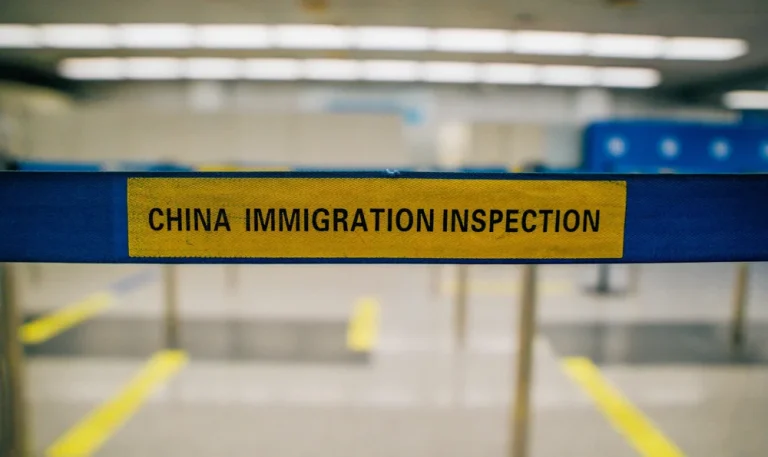
Look up the route from the airport all the way to the hotel entrance. A nearby subway stop can make rail appealing, while a long walk with cases can change the decision. Leave sightseeing until you’ve settled the transfer; the Beijing destination guide can help with what to do once your bags are put away.
Airport Express: match the interchange to your hotel
With the hotel address in hand, compare the Airport Express connections. The line has five stations: Beixinqiao, Dongzhimen, Sanyuanqiao, Terminal 3 and Terminal 2. Beixinqiao is the city endpoint, so an older description ending the line at Dongzhimen leaves out a useful connection.
The airport’s current transport page lists these city interchanges:
| Airport Express station | Connecting subway lines |
|---|---|
| Sanyuanqiao | Lines 10 and 12 |
| Dongzhimen | Lines 2 and 13 |
| Beixinqiao | Line 5 |
Choose the interchange that makes the rest of your journey manageable. Staying on until the city endpoint won’t necessarily put you closest to your hotel. Check the required transfers, the walk from the final station and the operating hours of every line you’ll need.
For light luggage and a straightforward subway connection, I’d choose rail. If the map shows repeated changes followed by a walk you’d rather avoid with cases, compare a taxi instead. The useful comparison is the whole arrival journey, including the effort of moving your bags.
T2 and T3: rail boarding levels, fare and departure times
Once the rail route works for your hotel, find the boarding location for your arrival terminal. The airport and Beijing’s station-area government guide publish the following details. All times are Beijing time; these are published service hours checked on November 13, 2026, rather than live departure predictions.
| Arrival terminal | Airport Express boarding location | First departure | Last departure |
|---|---|---|---|
| T2 | Basement level 2 of the T2 parking building | 06:36 | 23:10 |
| T3 | Level 2 of the T3 parking building | 06:22 | 22:52 |
The Airport Express single fare is CNY 25 per person. Budget for any onward city journey separately. Services are published as roughly ten minutes apart, subject to the operator’s actual announcements.
Follow the current Airport Express signs toward your terminal’s parking building. The levels differ between T2 and T3, so keep the terminal label attached to any saved directions. Neither photograph on this page identifies a rail entrance.
Near the last departure, check the onward subway connection as carefully as the airport train. Getting aboard the Airport Express doesn’t establish that another line will still be running when you reach the interchange. If the remaining journey is doubtful, make a road-transfer plan before heading for the platform.
Regular taxis: use the signed queue for your terminal
If a road transfer suits your bags or arrival time better, follow signs for the regular taxi queue. The airport lists T2 pickup on level 1, in the middle lane outside Doors 5–9. At T3, the regular taxi waiting area is on B1.
Ride-hailing has its own pickup areas. In particular, T3’s B2 H area is listed for ride-hailing, while B1 is the regular taxi waiting area. Follow the signs for the service you’ve chosen, rather than a generic instruction to meet in the parking building.
Show the driver your hotel’s Chinese name and complete address, and confirm where you’re going before leaving. The airport advises passengers to check the displayed fare rules and driver service card, and to ask for a receipt at the end. Its guidance also says passengers pay road and bridge tolls.
A taxi budget needs the destination and applicable charges. I haven’t established a reliable fixed airport-to-hotel price or journey time, so this guide doesn’t offer one. Use the displayed fare rules and current traffic information when deciding whether the convenience suits your budget.
Late arrivals and plans beyond the airport
After the final airport train, I would plan around a road transfer to the hotel. Keep the hotel’s arrival instructions and contact details available, and tell the property if you’ll arrive later than expected. A saved address is useful even when your original train plan changes.
Before travel, reopen Beijing Capital Airport’s official transport page and check the rail section and the pickup points for your terminal. On arrival, follow current notices for service changes. Published hours help you prepare, but they don’t guarantee a connection after a delayed flight or a long arrival queue.
For sightseeing after an arrival, use the shorter options in the Beijing one-day itinerary rather than committing to the full day before you know when you’ll reach town. The transfer and hotel stop belong in that day’s available time.
If you’re continuing directly to Xi’an, decide whether to cross Beijing at all before choosing a city transfer. The Beijing to Xi’an train guide compares the railway journey with flying onward and explains the station names. Keep that decision separate from a simple airport-to-hotel arrival.
Photo credits
Photo: Lumi W / Unsplash / Unsplash License. Cropped vertically to 1.9:1, resized to 1284 pixels wide and compressed to WebP.
Explore the Beijing city guide →