At Daxingshan Temple in Xi’an, the entrance plaques and the tree-lined courtyard give a Buddhist temple visit its focus. Start with the name above the gateway, then consider how the courtyard frames the hall. The temple’s Sui-Tang history adds context, while the surviving architecture needs its own dates.
The Daxingshan Temple gate carries a name and a tradition
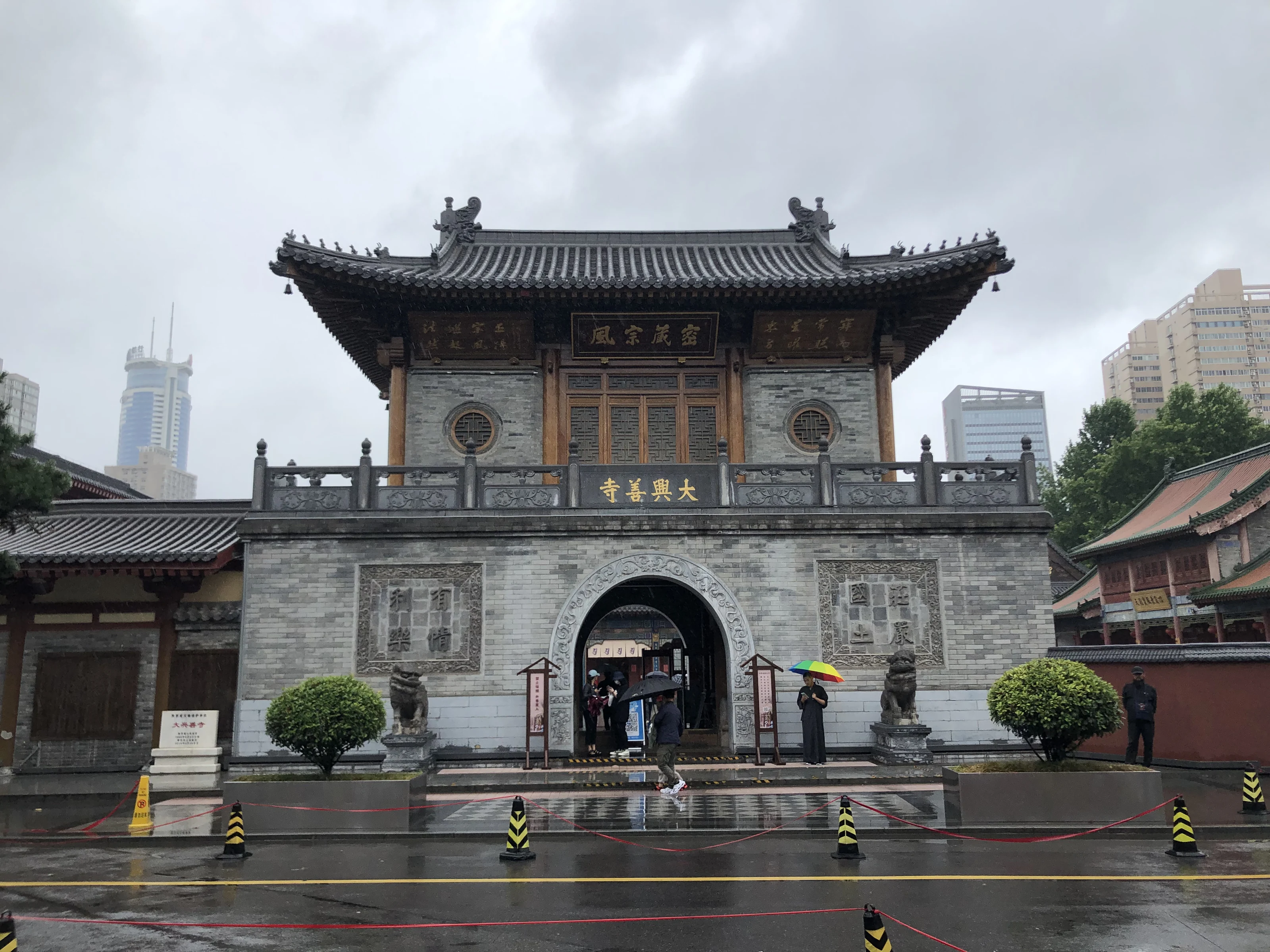
The featured photo shows a gray-brick gateway with round windows and a tiled roof. The lower central plaque names Daxingshan Temple (大兴善寺). Above it, 密藏宗风 refers to the tradition of esoteric Buddhism. The upper sign links the gate to a branch of Buddhist faith, giving the facade a role beyond marking a street entrance.
I’d begin with those central plaques before trying to read every line across the facade. Compare the brickwork, the round openings and the wood on the upper story. Modern buildings rise behind the gate, placing this temple frontage within the city.
Daxingshan is a separate temple from Daci’en Temple at the Giant Wild Goose Pagoda. If that tower was your intended destination, the Giant Wild Goose Pagoda visit guide explains its temple setting and the choice of an outside view.
Featured image explanation: The lower plaque reads Daxingshan Temple (大兴善寺); the upper plaque, 密藏宗风, refers to the tradition of esoteric Buddhism. Other smaller inscriptions are not fully transcribed. The photograph illustrates the gate’s appearance and does not identify a currently open visitor entrance.
The courtyard and hall
Beyond the facade, the courtyard photo shows a different scale: trees line a broad paved space, with an incense burner near the center and steps leading toward a hall. The yellow roof appears between the branches. The view draws the eye along the middle of the court, from the foreground paving to the building beyond.
The central plaque reads Five Buddhas of the Five Directions (五方五佛). The English name gives the hall front a more specific religious meaning than the roof color or building shape alone. You can read that plaque in the photo, though the view stops at the doors.
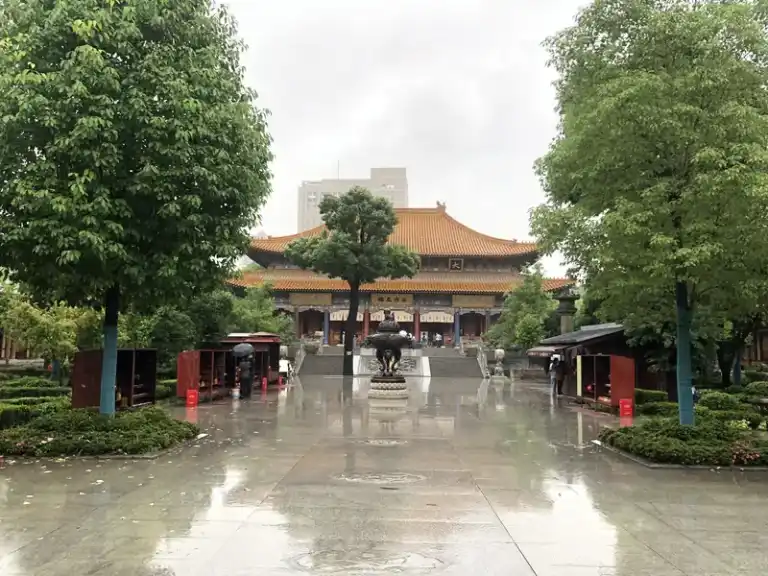
Photo credits
The plaque reads Five Buddhas of the Five Directions (五方五佛); 大 means great. Smaller inscriptions are not fully transcribed.
Photo: 木靈芝 / Wikimedia Commons / CC BY-SA 4.0. Full photograph resized to 800×600 and compressed as WebP; no crop. Derivative under CC BY-SA 4.0.
I find the relationship between the trees, the burner and the hall more useful here than a checklist of buildings. It gives you a way to study the space, including where the roof is hidden and where the central view opens up. Let the areas accessible on your visit determine how much of that setting you can explore.
Sui-Tang temple history and Qing architecture answer different questions
The courtyard raises a useful historical question: how old is the place you are looking at? Xi’an’s municipal government describes Daxingshan as a royal temple of the Sui and Tang dynasties. That establishes the temple’s place in the history of the imperial capital.
The city’s cultural heritage bureau supplies another kind of date. Its 2023 heritage inventory, published in 2024, lists Daxingshan Temple as Qing-period ancient architecture under provincial protection. The temple’s history and the date given for its protected buildings answer different questions.
A Sui-Tang temple history does not date every visible building to those dynasties. Equally, the Qing label does not tell you the age of each roof tile, window or painted surface in a photo. The bureau’s original heritage inventory records the site’s status, rather than proving that the whole view is untouched ancient fabric.
Locate Daxingshan before fixing the day’s other stops
For locating the temple, the municipal government’s 2021 article gives the address as No. 55 Xingshansi West Street, Yanta district, Xi’an. Save 大兴善寺 alongside the English name when checking your map. The address identifies the destination; confirm the usable visitor entrance separately.
For the wider day, the Xi’an city guide helps group major sights and leave time for the streets between them.
Current opening hours, entry fees, booking rules and passport entry have not been verified here. The older city article described free entry at the time; it is not a current admission promise. Check the temple’s latest official notices or ask its visitor staff about your date, entry point and any booking rule before building a tightly timed day around the visit.
Photo credits
Photo: 木靈芝 / Wikimedia Commons / CC BY-SA 4.0. Cropped to box (400,400,3632,2102), resized to 1200×632 and compressed as WebP. Derivative under CC BY-SA 4.0.

Explore the Xi’an city guide →