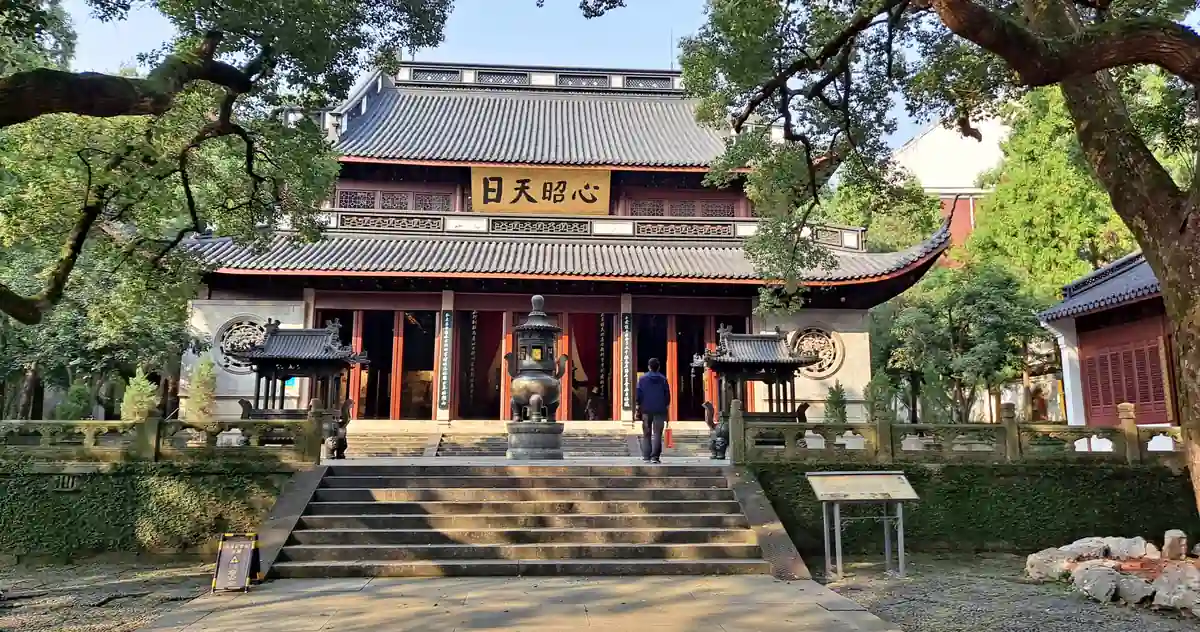
Yue Fei Temple in Hangzhou combines memorial halls with the tomb garden of the Southern Song general Yue Fei and his son Yue Yun. Give both spaces a place in the visit: the halls express respect through buildings and inscriptions, while the garden brings the graves themselves into view. The distinction makes this north-shore West Lake stop easier to understand before you arrive.
Distinguish the tomb garden from the memorial hall
The tomb garden belongs to the same memorial complex as the halls. Hangzhou’s municipal tourism brochure divides the site into three areas: Zhonglie Shrine (忠烈祠), the tomb garden, and Qizhong Shrine (启忠祠). These names are useful for finding the separate areas on a site plan, even when an English map calls the whole complex “Yue Fei Temple.”
In the garden photograph, a paved approach passes between stone figures and rises by steps toward the tomb mounds and steles. Look past the stone figures. The tombs rise beyond the steps.
A photograph of the hall facade alone would leave the graves and their setting unexplained.
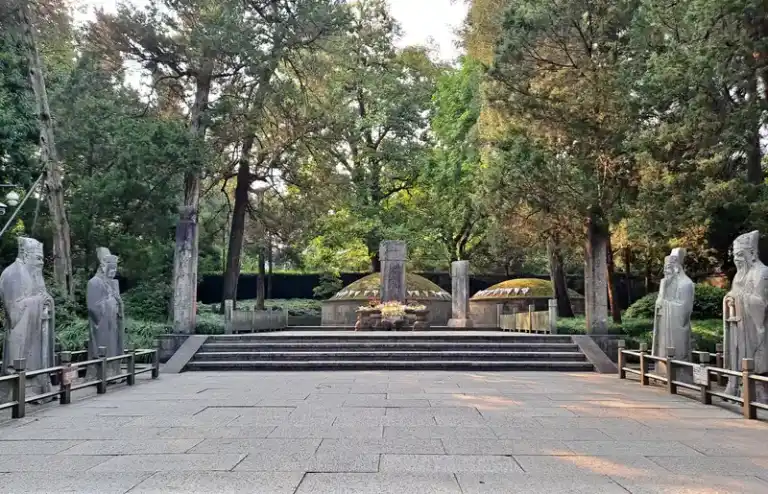

The main stele reads 宋岳鄂王墓: “Tomb of Yue, King of E, of the Song dynasty.” “King of E” is an honorific title attached to Yue Fei here; the inscription identifies the tomb. You don’t need to decipher the smaller inscriptions to grasp the garden’s purpose.
Use the Hangzhou destination guide to weigh a visit here against time in the tea hills or at the lake. The memorial suits an interest in the people remembered in Hangzhou’s landscape.
Read the memorial halls through Yue Fei’s story
The halls give the tomb garden its historical context. Yue Fei was a Southern Song military commander, remembered for his resistance to northern invaders and his execution after imprisonment. Hangzhou’s official English city portal describes the memorial’s origins as a later act of honor. Keep the general’s life and the later memorial buildings distinct when reading the displays.
I find the inscription a useful place to begin that reading. On the memorial hall’s gold plaque, 心昭天日 is read from right to left and can be rendered “His heart is manifest to heaven and the sun.” The words praise the clarity of his loyalty and intentions. They help explain the praise expressed by the building without requiring a long account of every battle.
A memorial inscription expresses how a person is honored. Treat stories, attributed sayings and later praise as separate kinds of evidence when exploring Yue Fei’s life. Read the labels for the particular object or episode in front of you, especially when a familiar legend seems to supply the answer already.
Travelers choosing between this visit and Lingyin have different subjects to weigh. Yue Fei’s memorial centers on a historical figure and his tomb; the Lingyin visit guide covers Buddhist halls, Feilai Peak carvings and that site’s reservation arrangements.
Fit Yue Fei Temple into a north-shore West Lake visit
With the halls and graves as the focus, a selected stretch of lakeside walking makes a sensible companion. Save the Chinese destination name 岳王庙 and the address, 80 Beishan Road (北山路80号), in your map. The municipal tourism brochure places the memorial here on the north side of West Lake.
I’d choose the memorial when the lake day needs a historical stop with something specific to read and recognize. Leave time for the garden as well as the halls, then decide how much shoreline walking fits around the entry arrangements and your return journey. A full circuit of West Lake needn’t be the goal.
The Hangzhou one-day itinerary uses a lake walk with either Lingyin or Longjing as its main outline. If Yue Fei’s story is the stronger interest, let the memorial replace part of that sightseeing plan. Adding every named attraction makes the time inside each one harder to protect.
Check Yue Fei Temple admission before fixing the day
The memorial’s location and layout help with planning, but admission needs a separate check. Current ticket prices, opening and last-entry times, reservation requirements, and passport purchase or verification have not been confirmed for this guide. The municipal tourism brochure is an older reference; its ticket and hours listings don’t establish the arrangements for your travel date.
Before setting out, ask the venue to confirm the admission channel, accepted identity document, last entry and which areas are open. For a passport visit, ask specifically how purchase and entry verification work. If step-free access matters, ask about a continuous route through both the hall area and the tomb garden; the garden photograph shows steps but cannot establish the accessible route.
Once those details are settled, save the entry information alongside the map pin. Keep the hall and tomb garden together in the plan so the memorial has room to tell its own story.
Written by Alex Chen, founder and editor of China Culture Way.
Featured image explanation: The hall’s gold plaque reads 心昭天日 from right to left, meaning “His heart is manifest to heaven and the sun.”
Photo credits
Photo: 钉钉 / Wikimedia Commons / CC BY-SA 4.0. Cropped from (0,500) to (3916,2561), resized to 1200 × 632 and compressed as WebP. No retouching or text added. Derivative under CC BY-SA 4.0.

Explore the Hangzhou city guide →