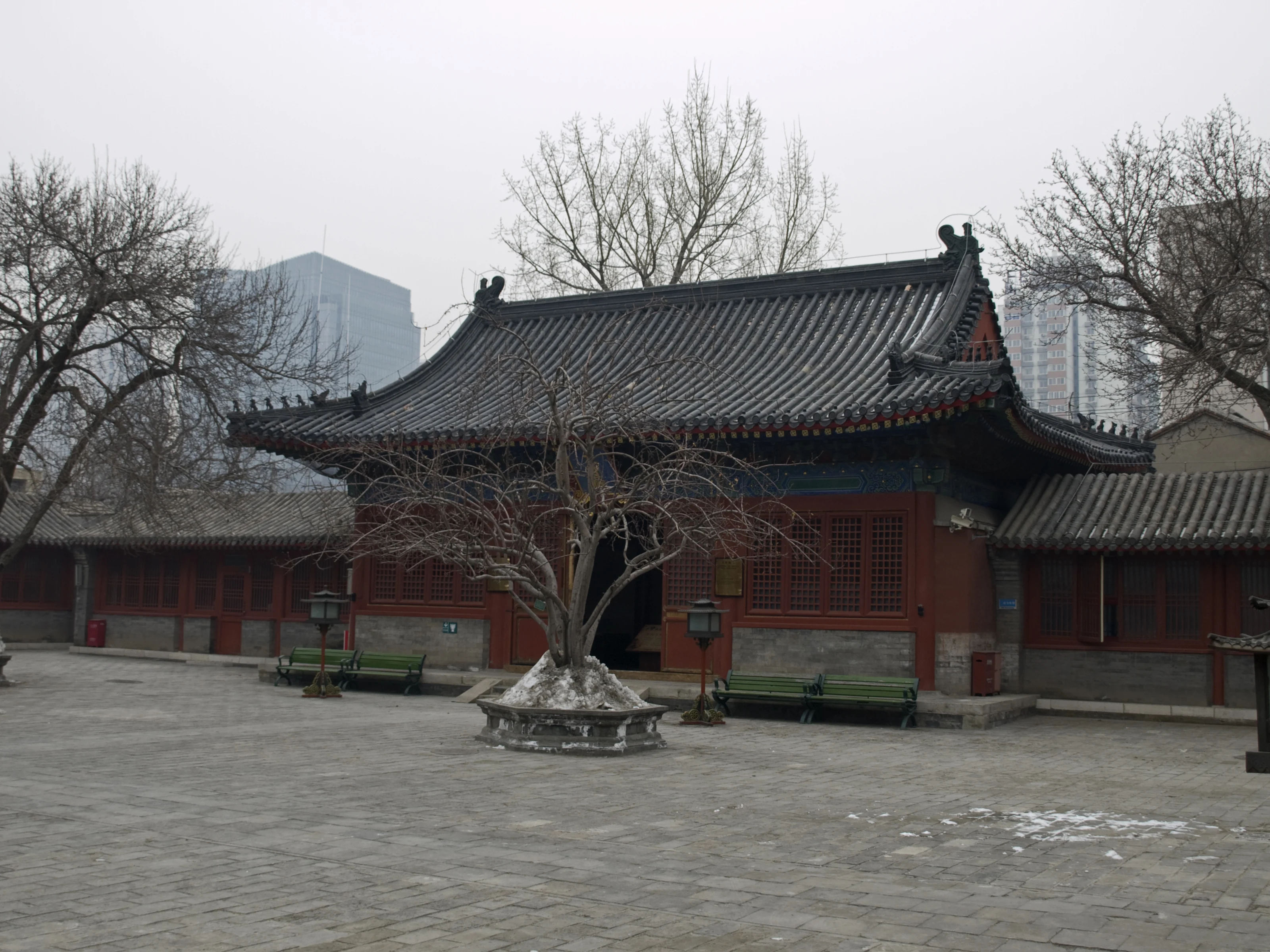
Zhihua Temple in Beijing rewards a visit built around its black-tiled halls and Buddhist music tradition. The roofs give you something to read even on a day without a performance: dark tiles above red doors, with painted bands tucked beneath the eaves. I’d choose this temple for that close attention to a building, then arrange the music around a confirmed session.
Reading the black-tiled halls
Beijing’s municipal government describes Zhihua as a Ming-era monastery built in 1443, with black glazed roof tiles and decorative paintings. That description gives the visit a useful starting point. Take in the roof’s broad sweep, then let your eye move down to the colored strip beneath it and the red lattice windows below.
The courtyard photograph shows how those parts sit together. The dark roofs occupy the upper edges of the view, while red walls enclose the paved space. Beneath the nearest roof, painted details form a narrow band above the windows. Bare branches cross the rooflines, so the buildings are read through the trees as well as across the open court.
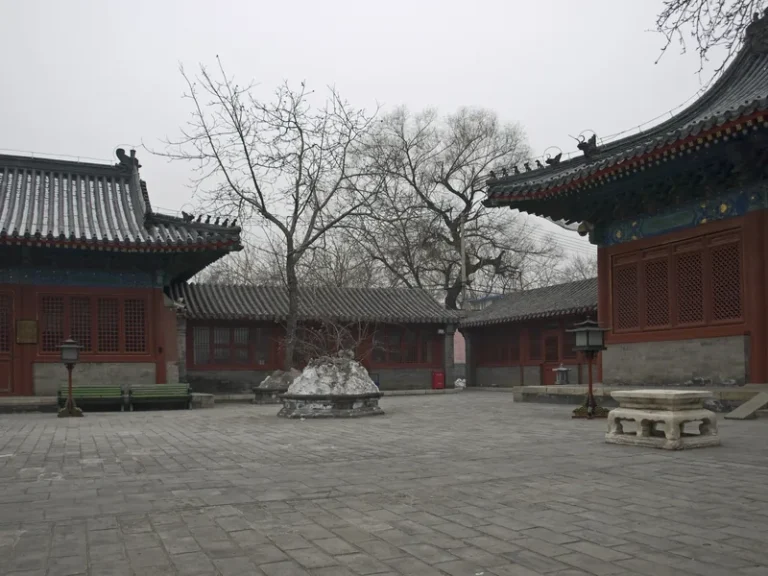
Photo credits

I find the change in scale worth lingering over: a whole roof reads clearly from across the courtyard, while the painted wood asks for a closer look from an open visitor path. There’s no need to identify every decorative motif to see that difference. The shape overhead and the detail beneath it offer separate reasons to pause.
Palace visits, neighborhood walks and Great Wall outings form the starting points in the Beijing destination guide. Zhihua adds a temple visit focused on wood, tile and music to those choices.
What the temple’s Buddhist music adds
The buildings provide the setting for another part of Zhihua’s heritage. The same municipal account identifies a tradition called jing yinyue (京音乐), or “Capital Music,” associated with the temple. Here, “music” belongs to a Buddhist temple tradition, rather than serving as a general label for entertainment elsewhere in Beijing.
If hearing it is the main reason for coming, let a confirmed performance determine your arrival. Ask whether there is a session on your date, when visitors should be there and whether any separate admission arrangement applies. A temple opening time tells you when the site admits visitors; it doesn’t establish when musicians will perform.
I’d still keep the architectural visit in mind while making that decision. The roofs and painted eaves give the day a subject of their own. If a session is available, hearing the music adds sound to the setting you’ve been looking at. If no session is confirmed, decide whether the halls alone are enough reason for the journey.
For a different account of religion and architecture in the city, the Temple of Heaven guide explains its imperial ceremonies and the areas covered by its tickets. Those ceremonies belong to a different site and history; Zhihua’s focus here is a Buddhist monastery and its musical tradition.
Finding Zhihua and checking admission
Once the music question is settled, the dated visitor information helps with the rest of the plan. The Beijing government entry published on November 10, 2026 gives the address as 5 Lumicang Hutong, Dongcheng District. Save the temple name, 智化寺, and the address, 禄米仓胡同5号, in your map app so the destination is clear.
That notice lists Tuesday–Sunday opening from 9 a.m. to 5 p.m., with last entry at 4:30 p.m., and a ticket price of CNY 20 per person. All times are Beijing time. These details come from the notice’s indexed text: the original page could not be reopened during research, so treat them as a dated reference to confirm for your visit.
The dated source is the Beijing government’s Zhihua Temple entry, which may also carry an update when you can open it. Current booking, passport, payment and holiday arrangements still need confirmation. The photographs date from December 2012 and show the architecture; they don’t establish today’s room access or performance program.
Before committing the journey, settle the part that matters most to you: the day’s admission arrangements for a building visit, or a confirmed session for a music-led visit. That answer gives the temple a clear place in your Beijing plans.
Written by Alex Chen, founder and editor of China Culture Way.
Featured image explanation: Photographed in December 2012. Small signs are too distant to read in this view. The image shows a dark tiled roof, red lattice doors and a bare tree in the courtyard.
Photo credits
Photo: Ymblanter / Wikimedia Commons / CC BY-SA 4.0. Cropped from 3648×2736 to 3648×1921 (box 0,350,3648,2271), resized to 1200×632 and compressed as WebP. Derivative under CC BY-SA 4.0.

Explore the Beijing city guide →